Non-Specific Low Back Pain — Exercises Studied in Research
Research has examined 82 approaches for this condition. This page shows what the studies found and where clinical guidelines landed — with a source behind every claim.
Clinical guidelines support 10 of the 82 approaches studied for this condition.
Compiled and reviewed by: Nikola Orlandić — Specialist in Applied Physiotherapy — Neurorehabilitation · Bachelor — Technology, pharmaceutical module · L0104 · Milena Orlandić — Specialist in Applied Physiotherapy — Neurorehabilitation · L0105
Evidence last updated:
Partner of the Chamber of Physiotherapists of Montenegro
What studies found
Each approach below was tested in clinical research. Sorted by where clinical guidelines stand.
Advice to Stay Active
Evidence supports itSource: PubMed 35578230
Pain Neuroscience Education
Evidence supports itThis RCT reported that pain neuroscience education with graded exposure can work in an occupational setting, potentially beating Pilates and postural education on extensor muscle endurance, catastrophizing, and fear avoidance, and matching them on pain intensity and disability.
Source: PubMed 36111620
Postural Exercise
Evidence supports itsimilarly as beneficial for pain intensity and disability
Source: PubMed 36111620
How these exercises and approaches were done in the studies — all in one document
Finished physiotherapy? Keep exercising live with a physiotherapist
Every programme is built on evidence-based principles and personalised only for you.
A separate online service run by licensed physiotherapists: live sessions, not recordings.
About the programme →Free first live session at the start · no minimum term
Exercises from the studies — how they were done
Which exercises, how often, for how long and how they were progressed — as published studies describe them, in one PDF document.
Delivered within 24 hours · Full refund within 14 days if the document does not contain what this page describes
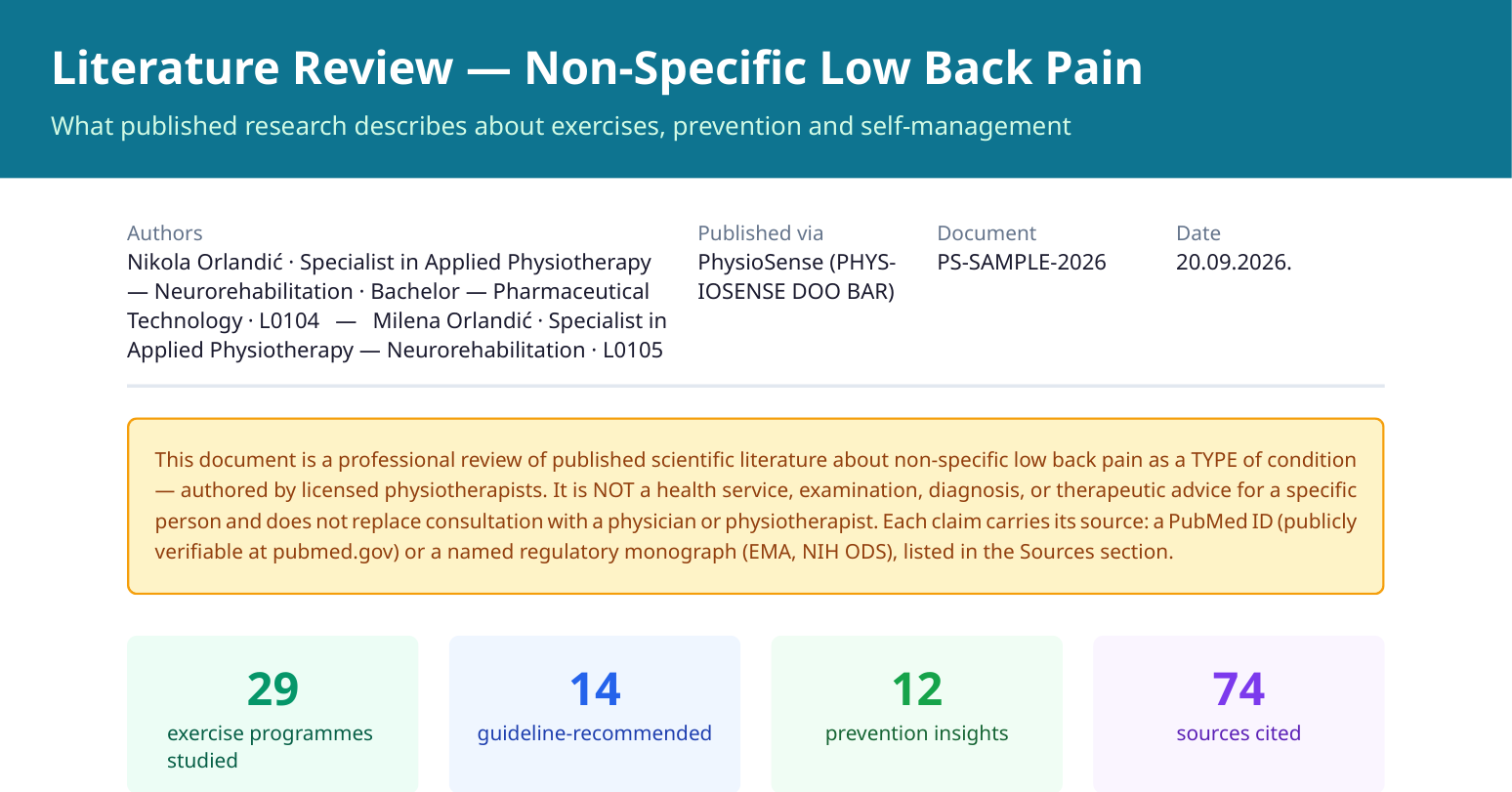
What this document does not do
- It does not examine anyone or make a diagnosis.
- It does not make a plan for one person — it describes what published studies found in people with this condition.
- It does not replace a visit to a physician or a physiotherapist.
- It is written from published studies, not from your medical records.
Delivery language: the document is written in your selected language. Verbatim quotations from the source studies stay in their original language — translating them is not permitted, and it also lets you check every quote against the source.
See a sample report — Non-Specific Low Back Pain (PDF) →What science does not support
These approaches are widely offered, but published research found they do not help for this condition. Listed so you know before spending money — not as advice about any individual case.
- OpioidsNot supported by research
Belgian KCE 2020 (Van Wambeke) — LBP and Radicular Pain · NICE NG59 (2016) · ACP 2017 (Qaseem) · WHO 2023
- Paracetamol / AcetaminophenNot supported by research
NICE NG59 (2016) · ACP 2017 (Qaseem) · WHO 2023
- Disc Replacement (NOT RECOMMENDED)Not supported by research
Belgian KCE 2020 (Van Wambeke) — LBP and Radicular Pain · NICE NG59 (2016)
- Foot Orthotics / InsolesNot supported by research
Belgian KCE 2020 (Van Wambeke) — LBP and Radicular Pain · NICE NG59 (2016)
- Lumbar Supports / BracesNot supported by research
Belgian KCE 2020 (Van Wambeke) — LBP and Radicular Pain · NICE NG59 (2016)
- Lumbar TractionNot supported by research
Belgian KCE 2020 (Van Wambeke) — LBP and Radicular Pain · NICE NG59 (2016)
- TENSNot supported by research
Belgian KCE 2020 (Van Wambeke) — LBP and Radicular Pain · NICE NG59 (2016)
- Therapeutic UltrasoundNot supported by research
Belgian KCE 2020 (Van Wambeke) — LBP and Radicular Pain · NICE NG59 (2016)
- Antidepressants (SNRI/TCA)Not supported by research
NICE NG59 (2016)
- Bed Rest (NOT RECOMMENDED)Not supported by research
Zhou et al. 2024 (22-CPG synthesis, BMC Musculoskelet Disord)
- BenzodiazepinesNot supported by research
McKenzie et al. 2025 (22-CPG synthesis, Spine J)
- Interferential Current TherapyNot supported by research
NICE NG59 (2016)
- Percutaneous Electrical Nerve Stimulation (PENS)Not supported by research
NICE NG59 (2016)
- Rocker Sole ShoesNot supported by research
NICE NG59 (2016)
- Spinal Fusion (NOT RECOMMENDED)Not supported by research
NICE NG59 (2016)
Whether any of this applies to your situation is something your physiotherapist or doctor can assess after examining you.
Does it work? — what research found
Every approach studied for this condition, sorted by where clinical guidelines stand. Not by popularity or marketing — by published research.
| Approach | Studies | Reviewed by | What science says |
|---|---|---|---|
| Exercise Therapydone with a specialistStudies: 48 · Belgian KCE 2020 (Van Wambeke) — LBP and Radicular Pain, NICE NG59 (2016) +1 | 48 | Belgian KCE 2020 (Van Wambeke) — LBP and Radicular PainNICE NG59 (2016) +1 | Evidence supports it |
| General Home Exerciseyou can do this at homeStudies: 58 · Belgian KCE 2020 (Van Wambeke) — LBP and Radicular Pain, NICE NG59 (2016) +1 | 58 | Belgian KCE 2020 (Van Wambeke) — LBP and Radicular PainNICE NG59 (2016) +1 | Evidence supports it |
| Qigong (Home Practice)you can do this at homeStudies: 2 · Belgian KCE 2020 (Van Wambeke) — LBP and Radicular Pain, NICE NG59 (2016) +1 | 2 | Belgian KCE 2020 (Van Wambeke) — LBP and Radicular PainNICE NG59 (2016) +1 | Evidence supports it |
| Strengthening (Home)you can do this at homeStudies: 3 · Belgian KCE 2020 (Van Wambeke) — LBP and Radicular Pain, NICE NG59 (2016) +1 | 3 | Belgian KCE 2020 (Van Wambeke) — LBP and Radicular PainNICE NG59 (2016) +1 | Evidence supports it |
| Advice to Stay Activedone with a specialistStudies: 7 RCTs (as listed in Table 2 for Dahm 2010: '1923 (7 RCTs)') · Zhou et al. 2024 (22-CPG synthesis, BMC Musculoskelet Disord) | 7 RCTs (as listed in Table 2 for Dahm 2010: '1923 (7 RCTs)') | Zhou et al. 2024 (22-CPG synthesis, BMC Musculoskelet Disord) | Evidence supports it |
| Advice to Stay Activeyou can do this at homeStudies: 3 · Zhou et al. 2024 (22-CPG synthesis, BMC Musculoskelet Disord) | 3 | Zhou et al. 2024 (22-CPG synthesis, BMC Musculoskelet Disord) | Evidence supports it |
| Back School / Back Educationyou can do this at homeStudies: 12 · Zhou et al. 2024 (22-CPG synthesis, BMC Musculoskelet Disord) | 12 | Zhou et al. 2024 (22-CPG synthesis, BMC Musculoskelet Disord) | Evidence supports it |
| Pain Neuroscience Educationyou can do this at homeStudies: 4 · McKenzie et al. 2025 (22-CPG synthesis, Spine J) | 4 | McKenzie et al. 2025 (22-CPG synthesis, Spine J) | Evidence supports it |
| Postural Exerciseyou can do this at homeStudies: 3 · WHO 2023 | 3 | WHO 2023 | Evidence supports it |
| Self-Management Programyou can do this at homeStudies: 9 · WHO 2023 | 9 | WHO 2023 | Evidence supports it |
| NSAIDsdone with a specialistStudies: 3 · Belgian KCE 2020 (Van Wambeke) — LBP and Radicular Pain, NICE NG59 (2016) +2 | 3 | Belgian KCE 2020 (Van Wambeke) — LBP and Radicular PainNICE NG59 (2016) +2 | May help |
| CBT Self-Helpyou can do this at homeStudies: 3 · NICE NG59 (2016), ACP 2017 (Qaseem) +1 | 3 | NICE NG59 (2016)ACP 2017 (Qaseem) +1 | May help |
Show all 82 approaches ↓
| Approach | Studies | Reviewed by | What science says |
|---|---|---|---|
| Cognitive Behavioural Therapy (CBT)done with a specialistStudies: 14 · NICE NG59 (2016), ACP 2017 (Qaseem) +1 | 14 | NICE NG59 (2016)ACP 2017 (Qaseem) +1 | May help |
| Massage Therapydone with a specialistStudies: 1 · ACP 2017 (Qaseem), WHO 2023 | 1 | ACP 2017 (Qaseem)WHO 2023 | May help |
| Self-Massage / Foam Rollingyou can do this at homeStudies: 2 · ACP 2017 (Qaseem), WHO 2023 | 2 | ACP 2017 (Qaseem)WHO 2023 | May help |
| Spinal Manipulation (HVLA)done with a specialistStudies: 10 · ACP 2017 (Qaseem), WHO 2023 | 10 | ACP 2017 (Qaseem)WHO 2023 | May help |
| Aerobic Exercise (Home)you can do this at homeStudies: 4 · McKenzie et al. 2025 (22-CPG synthesis, Spine J) | 4 | McKenzie et al. 2025 (22-CPG synthesis, Spine J) | May help |
| Cold / Cryotherapydone with a specialistStudies: 2 · Zhou et al. 2024 (22-CPG synthesis, BMC Musculoskelet Disord) | 2 | Zhou et al. 2024 (22-CPG synthesis, BMC Musculoskelet Disord) | May help |
| Cold Therapy (Self-Applied)you can do this at homeStudies: 3 · Zhou et al. 2024 (22-CPG synthesis, BMC Musculoskelet Disord) | 3 | Zhou et al. 2024 (22-CPG synthesis, BMC Musculoskelet Disord) | May help |
| Dry Needlingdone with a specialistStudies: 4 · McKenzie et al. 2025 (22-CPG synthesis, Spine J) | 4 | McKenzie et al. 2025 (22-CPG synthesis, Spine J) | May help |
| Fear Avoidance Therapydone with a specialistStudies: 2 · McKenzie et al. 2025 (22-CPG synthesis, Spine J) | 2 | McKenzie et al. 2025 (22-CPG synthesis, Spine J) | May help |
| Low-Level Laser Therapy (LLLT)done with a specialistStudies: 2 · ACP 2017 (Qaseem) | 2 | ACP 2017 (Qaseem) | May help |
| McKenzie Method (Home)you can do this at homeStudies: 8 · McKenzie et al. 2025 (22-CPG synthesis, Spine J) | 8 | McKenzie et al. 2025 (22-CPG synthesis, Spine J) | May help |
| McKenzie Method (MDT)done with a specialistStudies: 10 · McKenzie et al. 2025 (22-CPG synthesis, Spine J) | 10 | McKenzie et al. 2025 (22-CPG synthesis, Spine J) | May help |
| Mindfulness / Meditationyou can do this at homeStudies: 6 · ACP 2017 (Qaseem) | 6 | ACP 2017 (Qaseem) | May help |
| Mobility Assistive Productsdone with a specialistStudies: 1 · WHO 2023 | 1 | WHO 2023 | May help |
| Operant Therapy / Graded Activitydone with a specialistStudies: 7 trials (graded activity vs minimal intervention); 6 trials (graded activity vs other exercise) · ACP 2017 (Qaseem) | 7 trials (graded activity vs minimal intervention); 6 trials (graded activity vs other exercise) | ACP 2017 (Qaseem) | May help |
| Radiofrequency Denervationdone with a specialistStudies: 12 · NICE NG59 (2016) | 12 | NICE NG59 (2016) | May help |
| Relaxation Techniquesyou can do this at homeStudies: 3 · ACP 2017 (Qaseem) | 3 | ACP 2017 (Qaseem) | May help |
| Return to Work Programdone with a specialistStudies: 2 · Zhou et al. 2024 (22-CPG synthesis, BMC Musculoskelet Disord) | 2 | Zhou et al. 2024 (22-CPG synthesis, BMC Musculoskelet Disord) | May help |
| Spinal Mobilisationdone with a specialistStudies: 10 · NICE NG59 (2016) | 10 | NICE NG59 (2016) | May help |
| Tai Chidone with a specialistStudies: 4 · ACP 2017 (Qaseem) | 4 | ACP 2017 (Qaseem) | May help |
| Tai Chi (Home Practice)you can do this at homeStudies: 2 RCTs · ACP 2017 (Qaseem) | 2 RCTs | ACP 2017 (Qaseem) | May help |
| Topical Capsaicin (Cayenne Pepper)done with a specialistStudies: 1 · WHO 2023 | 1 | WHO 2023 | May help |
| Walking Programyou can do this at homeStudies: 5 · ACP 2017 (Qaseem) | 5 | ACP 2017 (Qaseem) | May help |
| Yogadone with a specialistStudies: 6 · ACP 2017 (Qaseem) | 6 | ACP 2017 (Qaseem) | May help |
| Yoga (Home Practice)you can do this at homeStudies: 7 · ACP 2017 (Qaseem) | 7 | ACP 2017 (Qaseem) | May help |
| Aquatic Exercise / Hydrotherapydone with a specialistStudies: 5 · not yet reviewed | 5 | not yet reviewed | May help |
| Core Stabilization (Home)you can do this at homeStudies: 10 · not yet reviewed | 10 | not yet reviewed | May help |
| Core Stabilization / Motor Control Exercisedone with a specialistStudies: 11 · not yet reviewed | 11 | not yet reviewed | May help |
| Cupping Therapydone with a specialistStudies: 2 · not yet reviewed | 2 | not yet reviewed | May help |
| Heat Therapy (Self-Applied)you can do this at homeStudies: nine studies · not yet reviewed | nine studies | not yet reviewed | May help |
| Patient Educationyou can do this at homeStudies: 19 · not yet reviewed | 19 | not yet reviewed | May help |
| Pilates (Home)you can do this at homeStudies: 4 · not yet reviewed | 4 | not yet reviewed | May help |
| Post-Surgical Rehabilitation (Lumbar)done with a specialistStudies: 3 · not yet reviewed | 3 | not yet reviewed | May help |
| Psychological Therapies (General)done with a specialistStudies: 31 trials · not yet reviewed | 31 trials | not yet reviewed | May help |
| Acupuncturedone with a specialistStudies: 4 · NICE NG59 (2016), ACP 2017 (Qaseem) +1 | 4 | NICE NG59 (2016)ACP 2017 (Qaseem) +1 | Not enough research yet |
| Muscle Relaxantsdone with a specialistStudies: 49 trials included in review, 31 quantitatively analysed · Belgian KCE 2020 (Van Wambeke) — LBP and Radicular Pain, ACP 2017 (Qaseem) +1 | 49 trials included in review, 31 quantitatively analysed | Belgian KCE 2020 (Van Wambeke) — LBP and Radicular PainACP 2017 (Qaseem) +1 | Not enough research yet |
| Lumbar Surgery (vs Conservative Care)done with a specialistStudies: 1 · McKenzie et al. 2025 (22-CPG synthesis, Spine J) | 1 | McKenzie et al. 2025 (22-CPG synthesis, Spine J) | Not enough research yet |
| Acceptance and Commitment Therapy (ACT)done with a specialistStudies: 2 · not yet reviewed | 2 | not yet reviewed | Not enough research yet |
| ACT Self-Helpyou can do this at homeStudies: 4 · not yet reviewed | 4 | not yet reviewed | Not enough research yet |
| Acupressuredone with a specialistStudies: 1 (secondary analysis of an RCT) · not yet reviewed | 1 (secondary analysis of an RCT) | not yet reviewed | Not enough research yet |
| Behavioural Therapydone with a specialistStudies: 8 · not yet reviewed | 8 | not yet reviewed | Not enough research yet |
| Biofeedbackdone with a specialistStudies: 21 eligible studies including 23 treatment conditions · not yet reviewed | 21 eligible studies including 23 treatment conditions | not yet reviewed | Not enough research yet |
| Cannabis-Based Medicinesdone with a specialistStudies: 24 research-controlled trials · not yet reviewed | 24 research-controlled trials | not yet reviewed | Not enough research yet |
| Cognitive Functional Therapydone with a specialistStudies: 2 · not yet reviewed | 2 | not yet reviewed | Not enough research yet |
| Electroacupuncturedone with a specialistStudies: 2 · not yet reviewed | 2 | not yet reviewed | Not enough research yet |
| High Intensity Laser Therapy (HILT)done with a specialistStudies: 5 · not yet reviewed | 5 | not yet reviewed | Not enough research yet |
| Intramuscular Electrical Stimulation (IMES)done with a specialistStudies: 1 · not yet reviewed | 1 | not yet reviewed | Not enough research yet |
| Kinesiotapingdone with a specialistStudies: 2 · not yet reviewed | 2 | not yet reviewed | Not enough research yet |
| Neuromuscular Electrical Stimulation (NMES)done with a specialistStudies: 2 · not yet reviewed | 2 | not yet reviewed | Not enough research yet |
| Perturbation Trainingdone with a specialistStudies: 1 · not yet reviewed | 1 | not yet reviewed | Not enough research yet |
| Shockwave Therapy (ESWT)done with a specialistStudies: 6 randomized clinical trials (RCTs) · not yet reviewed | 6 randomized clinical trials (RCTs) | not yet reviewed | Not enough research yet |
| Stretching / Flexibility Exercisedone with a specialistStudies: 4 · not yet reviewed | 4 | not yet reviewed | Not enough research yet |
| Telerehabilitationdone with a specialistStudies: 6 · not yet reviewed | 6 | not yet reviewed | Not enough research yet |
| Virtual Reality Rehabilitationdone with a specialistStudies: 4 · not yet reviewed | 4 | not yet reviewed | Not enough research yet |
| Opioidsdone with a specialistStudies: 2 · Belgian KCE 2020 (Van Wambeke) — LBP and Radicular Pain, NICE NG59 (2016) +2 | 2 | Belgian KCE 2020 (Van Wambeke) — LBP and Radicular PainNICE NG59 (2016) +2 | Science does not support it |
| Paracetamol / Acetaminophendone with a specialistStudies: 5 · NICE NG59 (2016), ACP 2017 (Qaseem) +1 | 5 | NICE NG59 (2016)ACP 2017 (Qaseem) +1 | Science does not support it |
| Disc Replacement (NOT RECOMMENDED)done with a specialistStudies: 1 · Belgian KCE 2020 (Van Wambeke) — LBP and Radicular Pain, NICE NG59 (2016) | 1 | Belgian KCE 2020 (Van Wambeke) — LBP and Radicular PainNICE NG59 (2016) | Science does not support it |
| Foot Orthotics / Insolesdone with a specialistStudies: 1 · Belgian KCE 2020 (Van Wambeke) — LBP and Radicular Pain, NICE NG59 (2016) | 1 | Belgian KCE 2020 (Van Wambeke) — LBP and Radicular PainNICE NG59 (2016) | Science does not support it |
| Lumbar Supports / Bracesdone with a specialistStudies: Sixteen randomized controlled trials (RCTs) were included in the systematic review, with eight studies analyzed in the meta-analysis · Belgian KCE 2020 (Van Wambeke) — LBP and Radicular Pain, NICE NG59 (2016) | Sixteen randomized controlled trials (RCTs) were included in the systematic review, with eight studies analyzed in the meta-analysis | Belgian KCE 2020 (Van Wambeke) — LBP and Radicular PainNICE NG59 (2016) | Science does not support it |
| Lumbar Tractiondone with a specialistStudies: 1 · Belgian KCE 2020 (Van Wambeke) — LBP and Radicular Pain, NICE NG59 (2016) | 1 | Belgian KCE 2020 (Van Wambeke) — LBP and Radicular PainNICE NG59 (2016) | Science does not support it |
| TENSdone with a specialistStudies: 4 · Belgian KCE 2020 (Van Wambeke) — LBP and Radicular Pain, NICE NG59 (2016) | 4 | Belgian KCE 2020 (Van Wambeke) — LBP and Radicular PainNICE NG59 (2016) | Science does not support it |
| Therapeutic Ultrasounddone with a specialistStudies: 1 · Belgian KCE 2020 (Van Wambeke) — LBP and Radicular Pain, NICE NG59 (2016) | 1 | Belgian KCE 2020 (Van Wambeke) — LBP and Radicular PainNICE NG59 (2016) | Science does not support it |
| Antidepressants (SNRI/TCA)done with a specialistStudies: 1 · NICE NG59 (2016) | 1 | NICE NG59 (2016) | Science does not support it |
| Bed Rest (NOT RECOMMENDED)done with a specialistStudies: 3 studies · Zhou et al. 2024 (22-CPG synthesis, BMC Musculoskelet Disord) | 3 studies | Zhou et al. 2024 (22-CPG synthesis, BMC Musculoskelet Disord) | Science does not support it |
| Benzodiazepinesdone with a specialistStudies: Four trials · McKenzie et al. 2025 (22-CPG synthesis, Spine J) | Four trials | McKenzie et al. 2025 (22-CPG synthesis, Spine J) | Science does not support it |
| Interferential Current Therapydone with a specialistStudies: 5 · NICE NG59 (2016) | 5 | NICE NG59 (2016) | Science does not support it |
| Percutaneous Electrical Nerve Stimulation (PENS)done with a specialistStudies: 1 · NICE NG59 (2016) | 1 | NICE NG59 (2016) | Science does not support it |
| Rocker Sole Shoesdone with a specialistStudies: 1 · NICE NG59 (2016) | 1 | NICE NG59 (2016) | Science does not support it |
| Spinal Fusion (NOT RECOMMENDED)done with a specialistStudies: Four randomized controlled trials · NICE NG59 (2016) | Four randomized controlled trials | NICE NG59 (2016) | Science does not support it |
| Systemic Corticosteroidsdone with a specialistStudies: Thirteen trials · ACP 2017 (Qaseem) | Thirteen trials | ACP 2017 (Qaseem) | Science does not support itdepends on the stage of recovery |
Prevention
Factors that published studies link to higher or lower risk for this condition.
Maintenance Exercise Program
Shown in prevention studiesThis systematic review reported low- to very low-quality evidence that exercise by itself could lower two risks - an LBP episode (0.65 [0.50-0.86]) and taking sick leave (0.22 [0.06-0.76]).
Source: PubMed 26752509
Exercise + Education Combined
Shown in prevention studiesThis systematic review found moderate-quality evidence that pairing exercise with education lowers the chance of an LBP episode (0.55 [0.41-0.74]), alongside low-quality evidence showing no impact on sick leave (0.74 [0.44-1.26]).
Source: PubMed 26752509
Fear-Avoidance Prevention (Graded Exposure)
Risk factor in studiesThis systematic review describes building activity tolerance through individualised, submaximal exercise, together with disregarding illness behaviours and reinforcing wellness behaviours.
Source: PubMed 26742533
Show all 12 prevention factors ↓
Physical Activity (150 min/week)
Shown in prevention studiesThis study concluded that a combination of strengthening with either stretching or aerobic exercise, performed 2-3 times per week, can reasonably be recommended for preventing LBP in the general population.
Source: PubMed 29053873
Patient Education + Self-Management
Risk factor in studiesIn people with acute or subacute LBP, this systematic review found that intensive patient education appears effective.
Source: PubMed 18254037
Psychosocial Prevention (CBT-based)
Risk factor in studiesThis study describes applying risk stratification - the STarT Back risk assessment tool, for instance - at a person's first contact with a healthcare professional over any fresh low-back-pain episode, sciatica present or not, to guide shared decisions on stratified management.
Source: PubMed 27929617
Smoking Cessation
Risk factor in studiesa positive causal effect of smoking on back pain
Source: PubMed 39090551
Weight Management (BMI <25)
Risk factor in studiesThis source indicates that obese individuals appear to be at greatest risk of reporting low back pain.
Source: PubMed 29573870
Return to Work Program
Risk factor in studiesIt stays uncertain, this systematic review concluded, whether physical conditioning within a return-to-work strategy reduces sick leave for workers with back pain relative to usual care or exercise therapy.
Source: PubMed 23990391
Self-Management Program
Risk factor in studiesRecommended by CPG consensus: 5/13 acute, 3/11 subacute, 3/14 chronic, 5/5 unspecified duration CPGs. Biopsychosocial model strongly recommended.
Source: PubMed Zhou_2024
Sleep Hygiene (7-9h)
Risk factor in studiesCBTi integrated in BEPM should be considered in the treatment of patients with nCSP and comorbid insomnia
Source: PubMed 39120902
Workplace Rehabilitation Program
Risk factor in studiesThis review failed to identify high-quality studies that supported any of the Bradford-Hill criteria to establish causality between occupational carrying and LBP
Source: PubMed 20447872
Frequently asked
What works for Non-Specific Low Back Pain according to research?
Research supports: Exercise Therapy, General Home Exercise, Qigong (Home Practice), Strengthening (Home), Advice to Stay Active, Advice to Stay Active. Based on Belgian KCE 2020 (Van Wambeke) — LBP and Radicular Pain; NICE NG59 (2016); ACP 2017 (Qaseem).
What does not work for Non-Specific Low Back Pain according to research?
Research found no benefit from routine use of: Opioids, Paracetamol / Acetaminophen, Disc Replacement (NOT RECOMMENDED), Foot Orthotics / Insoles, Lumbar Supports / Braces, Lumbar Traction. Based on Belgian KCE 2020 (Van Wambeke) — LBP and Radicular Pain; NICE NG59 (2016); ACP 2017 (Qaseem).
How much research is this based on?
For Non-Specific Low Back Pain, 82 approaches were evaluated, of which 56 have been reviewed by research bodies. Every data point traces to a published source.
Why do so many approaches say 'not enough research yet'?
Because that is the honest state of the research. 'Not enough research yet' means clinical guidelines have not taken a clear position, or few controlled trials exist for that approach. This page shows the entire landscape — not only the flattering rows.
What if the exercises don't lead to improvement?
Studies report results at the population level — individual responses vary. The literature also describes signs that call for a medical check (listed under 'When to see a doctor'), and a clinician is the right address for an individual assessment.
🚩 When to see a doctor
Some symptoms call for a medical check before any exercise: severe pain after an injury, numbness or tingling, weakness, fever with pain, night pain that does not ease, or bladder/bowel changes. If any of these are present, see a doctor first.
More safety signs →Healthcare professional?
The professional platform adds full source traceability — every data point leads to the exact study page.
Educational Information — PhysioSense is an educational reference tool based on published research. It does NOT replace a medical examination or physiotherapy assessment. If you have severe pain, new symptoms, or are unsure — see a doctor or physiotherapist. You always make the final decision about your exercise. Pain is a signal to stop.