Lateral Epicondylitis (Tennis Elbow) — Exercises Studied in Research
Research has examined 41 approaches for this condition. This page shows what the studies found and where clinical guidelines landed — with a source behind every claim.
Of 41 approaches studied, none currently reaches strong guideline support — the differences below show where each one stands.
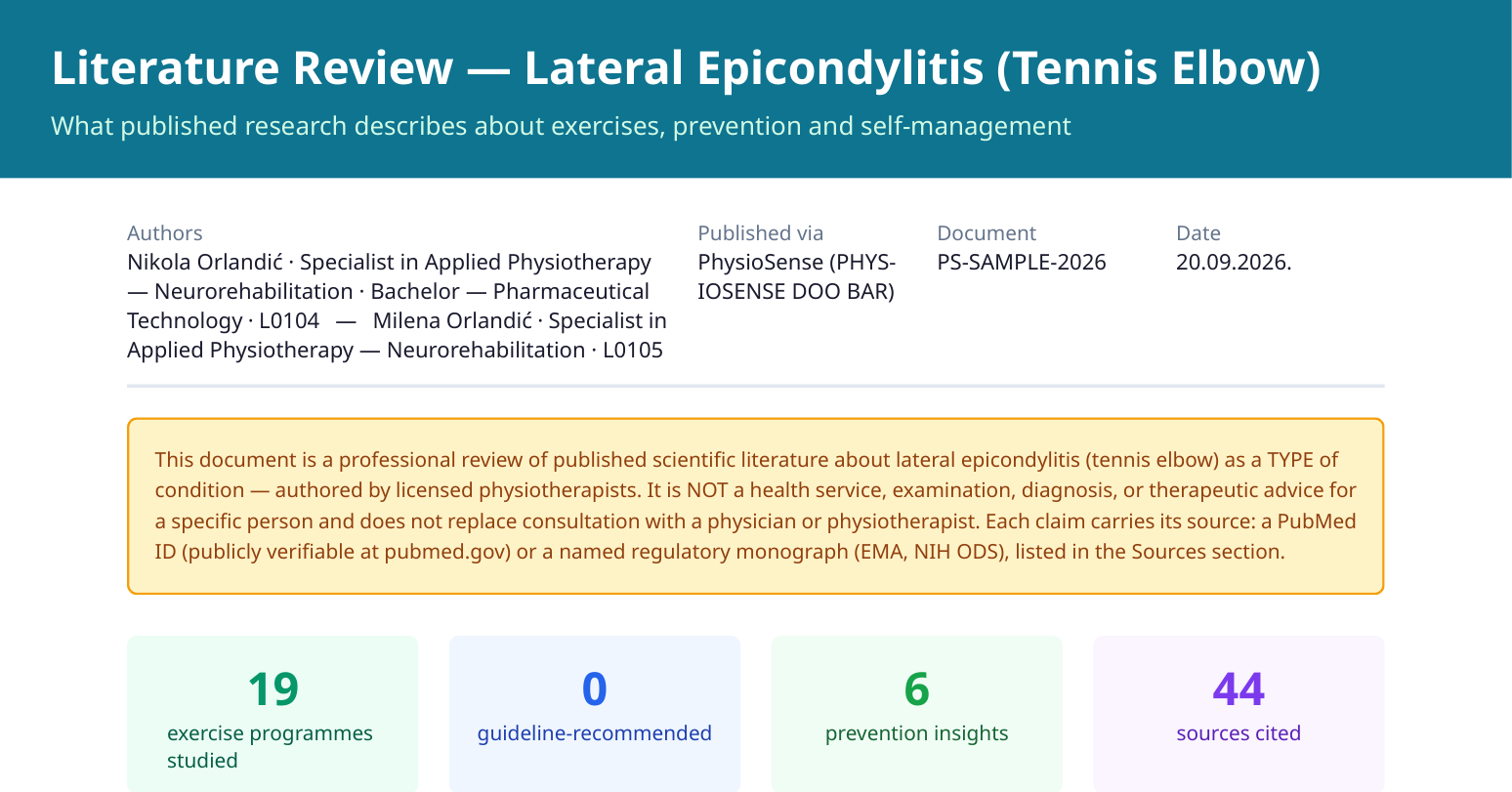
Compiled and reviewed by: Nikola Orlandić — Specialist in Applied Physiotherapy — Neurorehabilitation · Bachelor — Technology, pharmaceutical module · L0104 · Milena Orlandić — Specialist in Applied Physiotherapy — Neurorehabilitation · L0105
Evidence last updated:
Partner of the Chamber of Physiotherapists of Montenegro
What studies found
Each approach below was tested in clinical research. Sorted by where clinical guidelines stand.
Eccentric Exercise — Tyler Twist / FlexBar (Home)
May helpThere is a need to clarify the role of exercise in the management of LE, including optimal type and dosage of exercises
Source: PubMed 31516727
General Exercise Program (Home)
May helpnine sessions of LLLT in addition to exercise is effective in relieving pain, increasing grip strength, and improving subjective rating of physical function in the short term, and the effect can be maintained for at least 3 weeks
Source: PubMed 17508839
Isometric Wrist Extension (Home)
May helpan isometric strengthening exercise program early in the course of LE (within 4 weeks) provides clinically significant improvement
Source: PubMed 20808589
How these exercises and approaches were done in the studies — all in one document
Finished physiotherapy? Keep exercising live with a physiotherapist
Every programme is built on evidence-based principles and personalised only for you.
A separate online service run by licensed physiotherapists: live sessions, not recordings.
About the programme →Free first live session at the start · no minimum term
Exercises from the studies — how they were done
Which exercises, how often, for how long and how they were progressed — as published studies describe them, in one PDF document.
Delivered within 24 hours · Full refund within 14 days if the document does not contain what this page describes
What this document does not do
- It does not examine anyone or make a diagnosis.
- It does not make a plan for one person — it describes what published studies found in people with this condition.
- It does not replace a visit to a physician or a physiotherapist.
- It is written from published studies, not from your medical records.
Delivery language: the document is written in your selected language. Verbatim quotations from the source studies stay in their original language — translating them is not permitted, and it also lets you check every quote against the source.
See a sample report — Lateral Epicondylitis (Tennis Elbow) (PDF) →What science does not support
These approaches are widely offered, but published research found they do not help for this condition. Listed so you know before spending money — not as advice about any individual case.
- PhonophoresisNot supported by research
APTA 2022 CPG (Lucado)
Whether any of this applies to your situation is something your physiotherapist or doctor can assess after examining you.
Does it work? — what research found
Every approach studied for this condition, sorted by where clinical guidelines stand. Not by popularity or marketing — by published research.
| Approach | Studies | Reviewed by | What science says |
|---|---|---|---|
| Exercise Therapy (General)done with a specialistStudies: 14 · APTA 2022 CPG (Lucado), Wallis 2024 Cochrane (MT+Exercise) +2 | 14 | APTA 2022 CPG (Lucado)Wallis 2024 Cochrane (MT+Exercise) +2 | May help |
| General Exercise Program (Home)you can do this at homeStudies: 7 · APTA 2022 CPG (Lucado), Wallis 2024 Cochrane (MT+Exercise) +2 | 7 | APTA 2022 CPG (Lucado)Wallis 2024 Cochrane (MT+Exercise) +2 | May help |
| Isometric Wrist Extension (Home)you can do this at homeStudies: 4 · APTA 2022 CPG (Lucado), Wallis 2024 Cochrane (MT+Exercise) +2 | 4 | APTA 2022 CPG (Lucado)Wallis 2024 Cochrane (MT+Exercise) +2 | May help |
| Low-Level Laser Therapy (LLLT / PBM)done with a specialistStudies: 6 · APTA 2022 CPG (Lucado), Non-surgical NMA 2026 (time-dependent, VAS pain) +1 | 6 | APTA 2022 CPG (Lucado)Non-surgical NMA 2026 (time-dependent, VAS pain) +1 | May help |
| Dry Needlingdone with a specialistStudies: 5 · APTA 2022 CPG (Lucado), BESS Tennis Elbow care pathway 2023 (CPG) | 5 | APTA 2022 CPG (Lucado)BESS Tennis Elbow care pathway 2023 (CPG) | May help |
| Eccentric Exercise — Tyler Twist / FlexBar (Home)you can do this at homeStudies: 13 · APTA 2022 CPG (Lucado), Wallis 2024 Cochrane (MT+Exercise) | 13 | APTA 2022 CPG (Lucado)Wallis 2024 Cochrane (MT+Exercise) | May help |
| Eccentric Exercise (Tyler Twist / FlexBar)done with a specialistStudies: 13 · APTA 2022 CPG (Lucado), Wallis 2024 Cochrane (MT+Exercise) | 13 | APTA 2022 CPG (Lucado)Wallis 2024 Cochrane (MT+Exercise) | May help |
| Kinesiology Tapingdone with a specialistStudies: 4 · APTA 2022 CPG (Lucado), Non-surgical NMA 2026 (time-dependent, VAS pain) | 4 | APTA 2022 CPG (Lucado)Non-surgical NMA 2026 (time-dependent, VAS pain) | May help |
| Kinesiology Taping (Self-Applied)you can do this at homeStudies: 2 · APTA 2022 CPG (Lucado), Non-surgical NMA 2026 (time-dependent, VAS pain) | 2 | APTA 2022 CPG (Lucado)Non-surgical NMA 2026 (time-dependent, VAS pain) | May help |
| Manual Therapy (Elbow Mobilisation)done with a specialistStudies: 5 · APTA 2022 CPG (Lucado), Wallis 2024 Cochrane (MT+Exercise) | 5 | APTA 2022 CPG (Lucado)Wallis 2024 Cochrane (MT+Exercise) | May help |
| Patient Education & Self-Managementyou can do this at homeStudies: 6 · APTA 2022 CPG (Lucado), Wallis 2024 Cochrane (MT+Exercise) | 6 | APTA 2022 CPG (Lucado)Wallis 2024 Cochrane (MT+Exercise) | May help |
| TENS (Transcutaneous Electrical Nerve Stimulation)done with a specialistStudies: one low-quality study · APTA 2022 CPG (Lucado), TENS & ESWT SR+MA 2023 | one low-quality study | APTA 2022 CPG (Lucado)TENS & ESWT SR+MA 2023 | May help |
Show all 41 approaches ↓
| Approach | Studies | Reviewed by | What science says |
|---|---|---|---|
| Wrist Extensor Stretchingdone with a specialistStudies: 6 · APTA 2022 CPG (Lucado), Wallis 2024 Cochrane (MT+Exercise) | 6 | APTA 2022 CPG (Lucado)Wallis 2024 Cochrane (MT+Exercise) | May help |
| Wrist Extensor Stretching (Home)you can do this at homeStudies: 9 · APTA 2022 CPG (Lucado), Wallis 2024 Cochrane (MT+Exercise) | 9 | APTA 2022 CPG (Lucado)Wallis 2024 Cochrane (MT+Exercise) | May help |
| Acupuncturedone with a specialistStudies: 3 · Non-invasive therapies SR+MA 2024 (GRADE) | 3 | Non-invasive therapies SR+MA 2024 (GRADE) | May help |
| High-Intensity Laser Therapy (HILT / Nd:YAG)done with a specialistStudies: 2 · APTA 2022 CPG (Lucado) | 2 | APTA 2022 CPG (Lucado) | May help |
| Progressive Loading (Heavy Slow Resistance)done with a specialistStudies: 1 · Wallis 2024 Cochrane (MT+Exercise) | 1 | Wallis 2024 Cochrane (MT+Exercise) | May help |
| Progressive Loading / HSR (Home)you can do this at homeStudies: 6 · Wallis 2024 Cochrane (MT+Exercise) | 6 | Wallis 2024 Cochrane (MT+Exercise) | May help |
| Pulsed Electromagnetic Field Therapy (PEMF)done with a specialistStudies: 2 · PT vs electrophysio NMA 2022 (magnetic field) | 2 | PT vs electrophysio NMA 2022 (magnetic field) | May help |
| Scapular Stabilisationdone with a specialistStudies: 1 · APTA 2022 CPG (Lucado) | 1 | APTA 2022 CPG (Lucado) | May help |
| Scapular Stabilization (Home)you can do this at homeStudies: 8 · APTA 2022 CPG (Lucado) | 8 | APTA 2022 CPG (Lucado) | May help |
| Electroacupuncturedone with a specialistStudies: 2 · not yet reviewed | 2 | not yet reviewed | May help |
| Manual Therapy + Eccentric Exercisedone with a specialistStudies: 1 · not yet reviewed | 1 | not yet reviewed | May help |
| Platelet-Rich Plasma (PRP) Injectiondone with a specialistStudies: 6 · not yet reviewed | 6 | not yet reviewed | May help |
| TECAR Therapy (Capacitive-Resistive Energy Transfer)done with a specialistStudies: 1 · not yet reviewed | 1 | not yet reviewed | May help |
| Extracorporeal Shockwave Therapy (ESWT)done with a specialistStudies: 9 · APTA 2022 CPG (Lucado), BESS Tennis Elbow care pathway 2023 (CPG) +3 | 9 | APTA 2022 CPG (Lucado)BESS Tennis Elbow care pathway 2023 (CPG) +3 | Not enough research yet |
| Counterforce Brace (Self-Applied)you can do this at homeStudies: 7 · APTA 2022 CPG (Lucado), Wallis 2024 Cochrane (MT+Exercise) +2 | 7 | APTA 2022 CPG (Lucado)Wallis 2024 Cochrane (MT+Exercise) +2 | Not enough research yet |
| Counterforce Brace (Tennis Elbow Strap)done with a specialistStudies: 6 · APTA 2022 CPG (Lucado), Wallis 2024 Cochrane (MT+Exercise) +2 | 6 | APTA 2022 CPG (Lucado)Wallis 2024 Cochrane (MT+Exercise) +2 | Not enough research yet |
| Corticosteroid Injectiondone with a specialistStudies: 14 · Wallis 2024 Cochrane (MT+Exercise), BESS Tennis Elbow care pathway 2023 (CPG) +1 | 14 | Wallis 2024 Cochrane (MT+Exercise)BESS Tennis Elbow care pathway 2023 (CPG) +1 | Not enough research yet |
| Soft Tissue Mobilisation / Deep Friction Massagedone with a specialistStudies: 6 · APTA 2022 CPG (Lucado), Wallis 2024 Cochrane (MT+Exercise) | 6 | APTA 2022 CPG (Lucado)Wallis 2024 Cochrane (MT+Exercise) | Not enough research yet |
| Wrist Splint / Orthosisdone with a specialistStudies: 2 · APTA 2022 CPG (Lucado), BESS Tennis Elbow care pathway 2023 (CPG) | 2 | APTA 2022 CPG (Lucado)BESS Tennis Elbow care pathway 2023 (CPG) | Not enough research yet |
| Wrist Splint / Orthosis (Self-Applied)you can do this at homeStudies: 3 · APTA 2022 CPG (Lucado), BESS Tennis Elbow care pathway 2023 (CPG) | 3 | APTA 2022 CPG (Lucado)BESS Tennis Elbow care pathway 2023 (CPG) | Not enough research yet |
| Acupuncture + Eccentric Exercisedone with a specialistStudies: 1 · not yet reviewed | 1 | not yet reviewed | Not enough research yet |
| Blood Flow Restriction + Conventional PTdone with a specialistStudies: 1 · not yet reviewed | 1 | not yet reviewed | Not enough research yet |
| Cold Therapy / Ice (Self-Applied)you can do this at homeStudies: 2 · not yet reviewed | 2 | not yet reviewed | Not enough research yet |
| Forearm Strengthening (Home)you can do this at homeStudies: 4 · not yet reviewed | 4 | not yet reviewed | Not enough research yet |
| Scapular Exercises + Conventional PTdone with a specialistStudies: 2 · not yet reviewed | 2 | not yet reviewed | Not enough research yet |
| Tendon Neuroplastic Training (Externally Paced Loading)done with a specialistStudies: 1 · not yet reviewed | 1 | not yet reviewed | Not enough research yet |
| TENS + Patient Educationdone with a specialistStudies: 1 · not yet reviewed | 1 | not yet reviewed | Not enough research yet |
| Therapeutic Ultrasounddone with a specialistStudies: 4 · APTA 2022 CPG (Lucado), Non-surgical NMA 2026 (time-dependent, VAS pain) +1 | 4 | APTA 2022 CPG (Lucado)Non-surgical NMA 2026 (time-dependent, VAS pain) +1 | Science does not support itdepends on the stage of recovery |
| Phonophoresisdone with a specialistStudies: 1 systematic review and 2 RCTs · APTA 2022 CPG (Lucado) | 1 systematic review and 2 RCTs | APTA 2022 CPG (Lucado) | Science does not support it |
Prevention
Factors that published studies link to higher or lower risk for this condition.
Education & Early Symptom Recognition
Risk factor in studiesThis RCT suggests that telephone-delivered joint protection education can function as a health service falling within preventive and protective intervention programmes for LE.
Source: PubMed 35723150
Ergonomic Workplace Modification (Keyboard, Tools)
Risk factor in studiesThis study indicates that ergonomic interventions are an option for managing LET symptoms, and that education, behavioral modification, ergonomic equipment, and workstation adjustments carry moderate support from best practice or standard of care.
Source: PubMed 36453071
Load Management / Activity Pacing
Risk factor in studiesThe intervention includes workplace-based exercise programs, evaluation of risk factors, and movement correction.
Source: PubMed 37299843
Show all 6 prevention factors ↓
Smoking Cessation (Lateral Epicondylitis Risk Reduction)
Risk factor in studiesThis analysis found that the odds of an individual with a current or past tobacco smoking history sustaining lateral epicondylitis was 1.49 times that of an individual with no tobacco smoking history (95% CI = 1.18-1.87, Z = 3.40, I2 = 0%, p < 0.001).
Source: PubMed 31543312
Sports Technique & Equipment Modification
Risk factor in studiesThis study reported that a larger grip size correlated with greater incidence in the older group, a pattern read as fitting the view that tennis elbow is a degenerative condition whose onset is accelerated by overuse of the arm and elbow; adjusting stroke technique and racket type effectively curbed recurrence, while the forearm brace fared worst.
Source: PubMed 474862
Pre-Activity Warm-Up Protocols
Risk factor in studiesIn addition, active warm-up and stretching programs were introduced as part of the workday to promote muscle endurance and improve resistance to repetitive stress.
Source: PubMed 37299843
Frequently asked
What does not work for Lateral Epicondylitis (Tennis Elbow) according to research?
Research found no benefit from routine use of: Phonophoresis. Based on APTA 2022 CPG (Lucado).
How much research is this based on?
For Lateral Epicondylitis (Tennis Elbow), 41 approaches were evaluated, of which 30 have been reviewed by research bodies. Every data point traces to a published source.
Why do so many approaches say 'not enough research yet'?
Because that is the honest state of the research. 'Not enough research yet' means clinical guidelines have not taken a clear position, or few controlled trials exist for that approach. This page shows the entire landscape — not only the flattering rows.
What if the exercises don't lead to improvement?
Studies report results at the population level — individual responses vary. The literature also describes signs that call for a medical check (listed under 'When to see a doctor'), and a clinician is the right address for an individual assessment.
🚩 When to see a doctor
Some symptoms call for a medical check before any exercise: severe pain after an injury, numbness or tingling, weakness, fever with pain, night pain that does not ease, or bladder/bowel changes. If any of these are present, see a doctor first.
More safety signs →Healthcare professional?
The professional platform adds full source traceability — every data point leads to the exact study page.
Educational Information — PhysioSense is an educational reference tool based on published research. It does NOT replace a medical examination or physiotherapy assessment. If you have severe pain, new symptoms, or are unsure — see a doctor or physiotherapist. You always make the final decision about your exercise. Pain is a signal to stop.