Plantar Fasciitis — Exercises Studied in Research
Research has examined 27 approaches for this condition. This page shows what the studies found and where clinical guidelines landed — with a source behind every claim.
Clinical guidelines support 9 of the 27 approaches studied for this condition.
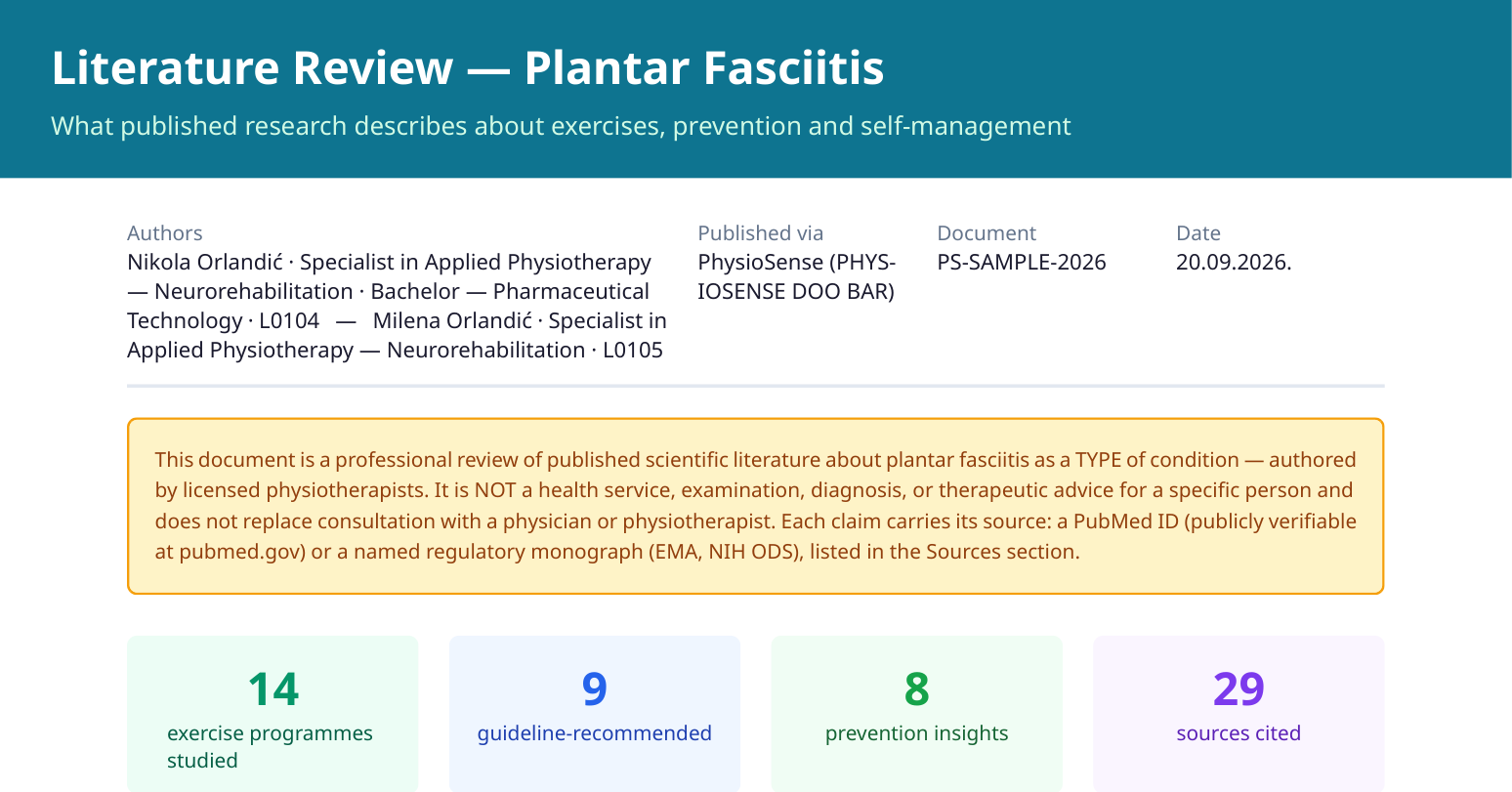
Compiled and reviewed by: Nikola Orlandić — Specialist in Applied Physiotherapy — Neurorehabilitation · Bachelor — Technology, pharmaceutical module · L0104 · Milena Orlandić — Specialist in Applied Physiotherapy — Neurorehabilitation · L0105
Evidence last updated:
Partner of the Chamber of Physiotherapists of Montenegro
What studies found
Each approach below was tested in clinical research. Sorted by where clinical guidelines stand.
Calf Stretching - Gastrocnemius & Soleus (Home)
Evidence supports itPRP injections and plantar-specific calf stretching exercises are equally effective in providing pain relief in plantar fasciitis; exercises are devoid of complications seen with PRP
Source: PubMed 39347302
Night Splint (Self-Applied)
Evidence supports itCAD/CAM foot orthoses designed based on dynamic plantar pressure with night splint can reduce the plantar fascia thickness and pain associated with plantar fasciitis and increase the activity of daily living, quality of life, and sports activity
Source: PubMed 36037272
Plantar Fascia-Specific Stretch (Home)
Evidence supports itBoth the strengthening and stretching exercise programs could reduce the pain and improve gait performance in patients with PF within 3 months.
Source: PubMed 31918529
How these exercises and approaches were done in the studies — all in one document
Finished physiotherapy? Keep exercising live with a physiotherapist
Every programme is built on evidence-based principles and personalised only for you.
A separate online service run by licensed physiotherapists: live sessions, not recordings.
About the programme →Free first live session at the start · no minimum term
Exercises from the studies — how they were done
Which exercises, how often, for how long and how they were progressed — as published studies describe them, in one PDF document.
Delivered within 24 hours · Full refund within 14 days if the document does not contain what this page describes
What this document does not do
- It does not examine anyone or make a diagnosis.
- It does not make a plan for one person — it describes what published studies found in people with this condition.
- It does not replace a visit to a physician or a physiotherapist.
- It is written from published studies, not from your medical records.
Delivery language: the document is written in your selected language. Verbatim quotations from the source studies stay in their original language — translating them is not permitted, and it also lets you check every quote against the source.
See a sample report — Plantar Fasciitis (PDF) →What science does not support
These approaches are widely offered, but published research found they do not help for this condition. Listed so you know before spending money — not as advice about any individual case.
- Therapeutic UltrasoundNot supported by research
Heel Pain - Plantar Fasciitis: Revision 2023 (APTA/AOPT) · Heel pain-plantar fasciitis: revision 2014.
Whether any of this applies to your situation is something your physiotherapist or doctor can assess after examining you.
Does it work? — what research found
Every approach studied for this condition, sorted by where clinical guidelines stand. Not by popularity or marketing — by published research.
| Approach | Studies | Reviewed by | What science says |
|---|---|---|---|
| Calf Stretching - Gastrocnemius & Soleus (Home)you can do this at homeStudies: 5 · Heel Pain - Plantar Fasciitis: Revision 2023 (APTA/AOPT), Management of plantar heel pain: a best practice guide informed by a systematic review, expert clinical reasoning and patient values. +1 | 5 | Heel Pain - Plantar Fasciitis: Revision 2023 (APTA/AOPT)Management of plantar heel pain: a best practice guide informed by a systematic review, expert clinical reasoning and patient values. +1 | Evidence supports it |
| Calf Stretching (Gastrocnemius & Soleus)done with a specialistStudies: 4 · Heel Pain - Plantar Fasciitis: Revision 2023 (APTA/AOPT), Management of plantar heel pain: a best practice guide informed by a systematic review, expert clinical reasoning and patient values. +1 | 4 | Heel Pain - Plantar Fasciitis: Revision 2023 (APTA/AOPT)Management of plantar heel pain: a best practice guide informed by a systematic review, expert clinical reasoning and patient values. +1 | Evidence supports it |
| Night Splint (Dorsiflexion Orthosis)done with a specialistStudies: 7 · Heel Pain - Plantar Fasciitis: Revision 2023 (APTA/AOPT), Management of plantar heel pain: a best practice guide informed by a systematic review, expert clinical reasoning and patient values. +1 | 7 | Heel Pain - Plantar Fasciitis: Revision 2023 (APTA/AOPT)Management of plantar heel pain: a best practice guide informed by a systematic review, expert clinical reasoning and patient values. +1 | Evidence supports it |
| Night Splint (Self-Applied)you can do this at homeStudies: 7 · Heel Pain - Plantar Fasciitis: Revision 2023 (APTA/AOPT), Management of plantar heel pain: a best practice guide informed by a systematic review, expert clinical reasoning and patient values. +1 | 7 | Heel Pain - Plantar Fasciitis: Revision 2023 (APTA/AOPT)Management of plantar heel pain: a best practice guide informed by a systematic review, expert clinical reasoning and patient values. +1 | Evidence supports it |
| Plantar Fascia-Specific Stretch (Home)you can do this at homeStudies: 7 · Heel Pain - Plantar Fasciitis: Revision 2023 (APTA/AOPT), Management of plantar heel pain: a best practice guide informed by a systematic review, expert clinical reasoning and patient values. +1 | 7 | Heel Pain - Plantar Fasciitis: Revision 2023 (APTA/AOPT)Management of plantar heel pain: a best practice guide informed by a systematic review, expert clinical reasoning and patient values. +1 | Evidence supports it |
| Plantar Fascia-Specific Stretchingdone with a specialistStudies: 12 · Heel Pain - Plantar Fasciitis: Revision 2023 (APTA/AOPT), Management of plantar heel pain: a best practice guide informed by a systematic review, expert clinical reasoning and patient values. +1 | 12 | Heel Pain - Plantar Fasciitis: Revision 2023 (APTA/AOPT)Management of plantar heel pain: a best practice guide informed by a systematic review, expert clinical reasoning and patient values. +1 | Evidence supports it |
| Manual Therapy — Joint Mobilization (Ankle/Foot)done with a specialistStudies: 2 · Heel Pain - Plantar Fasciitis: Revision 2023 (APTA/AOPT), Heel pain-plantar fasciitis: revision 2014. | 2 | Heel Pain - Plantar Fasciitis: Revision 2023 (APTA/AOPT)Heel pain-plantar fasciitis: revision 2014. | Evidence supports it |
| Radial Extracorporeal Shockwave Therapy (rESWT)done with a specialistStudies: 13 · Management of plantar heel pain: a best practice guide informed by a systematic review, expert clinical reasoning and patient values., Heel pain-plantar fasciitis: revision 2014. | 13 | Management of plantar heel pain: a best practice guide informed by a systematic review, expert clinical reasoning and patient values.Heel pain-plantar fasciitis: revision 2014. | Evidence supports it |
| High-Load Strength Training (Rathleff Protocol)done with a specialistStudies: 7 · Management of plantar heel pain: a best practice guide informed by a systematic review, expert clinical reasoning and patient values. | 7 | Management of plantar heel pain: a best practice guide informed by a systematic review, expert clinical reasoning and patient values. | Evidence supports it |
| Foot Orthoses (Prefabricated / Custom)done with a specialistStudies: 8 · Heel Pain - Plantar Fasciitis: Revision 2023 (APTA/AOPT), Management of plantar heel pain: a best practice guide informed by a systematic review, expert clinical reasoning and patient values. +1 | 8 | Heel Pain - Plantar Fasciitis: Revision 2023 (APTA/AOPT)Management of plantar heel pain: a best practice guide informed by a systematic review, expert clinical reasoning and patient values. +1 | May helpdepends on the stage of recovery |
| Foot Orthotic / Insole (Self-Applied)you can do this at homeStudies: 9 · Heel Pain - Plantar Fasciitis: Revision 2023 (APTA/AOPT), Management of plantar heel pain: a best practice guide informed by a systematic review, expert clinical reasoning and patient values. +1 | 9 | Heel Pain - Plantar Fasciitis: Revision 2023 (APTA/AOPT)Management of plantar heel pain: a best practice guide informed by a systematic review, expert clinical reasoning and patient values. +1 | May helpdepends on the stage of recovery |
| Low-Level Laser Therapy (LLLT / Photobiomodulation)done with a specialistStudies: 4 · Heel Pain - Plantar Fasciitis: Revision 2023 (APTA/AOPT), Management of plantar heel pain: a best practice guide informed by a systematic review, expert clinical reasoning and patient values. +1 | 4 | Heel Pain - Plantar Fasciitis: Revision 2023 (APTA/AOPT)Management of plantar heel pain: a best practice guide informed by a systematic review, expert clinical reasoning and patient values. +1 | May help |
Show all 27 approaches ↓
| Approach | Studies | Reviewed by | What science says |
|---|---|---|---|
| General Exercise / Aerobic Activitydone with a specialistStudies: 4 · Heel Pain - Plantar Fasciitis: Revision 2023 (APTA/AOPT), Heel pain-plantar fasciitis: revision 2014. | 4 | Heel Pain - Plantar Fasciitis: Revision 2023 (APTA/AOPT)Heel pain-plantar fasciitis: revision 2014. | May help |
| High-Load Heel Raises - Rathleff Protocol (Home)you can do this at homeStudies: 4 · Heel Pain - Plantar Fasciitis: Revision 2023 (APTA/AOPT), Heel pain-plantar fasciitis: revision 2014. | 4 | Heel Pain - Plantar Fasciitis: Revision 2023 (APTA/AOPT)Heel pain-plantar fasciitis: revision 2014. | May help |
| Intrinsic Foot Muscle Strengtheningdone with a specialistStudies: 2 · Heel Pain - Plantar Fasciitis: Revision 2023 (APTA/AOPT), Heel pain-plantar fasciitis: revision 2014. | 2 | Heel Pain - Plantar Fasciitis: Revision 2023 (APTA/AOPT)Heel pain-plantar fasciitis: revision 2014. | May help |
| Intrinsic Foot Strengthening (Home)you can do this at homeStudies: 2 · Heel Pain - Plantar Fasciitis: Revision 2023 (APTA/AOPT), Heel pain-plantar fasciitis: revision 2014. | 2 | Heel Pain - Plantar Fasciitis: Revision 2023 (APTA/AOPT)Heel pain-plantar fasciitis: revision 2014. | May help |
| Kinesiology Tapingdone with a specialistStudies: 1 · Heel Pain - Plantar Fasciitis: Revision 2023 (APTA/AOPT), Heel pain-plantar fasciitis: revision 2014. | 1 | Heel Pain - Plantar Fasciitis: Revision 2023 (APTA/AOPT)Heel pain-plantar fasciitis: revision 2014. | May help |
| Patient Education & Self-Managementyou can do this at homeStudies: 1 · Management of plantar heel pain: a best practice guide informed by a systematic review, expert clinical reasoning and patient values., Heel pain-plantar fasciitis: revision 2014. | 1 | Management of plantar heel pain: a best practice guide informed by a systematic review, expert clinical reasoning and patient values.Heel pain-plantar fasciitis: revision 2014. | May help |
| Gait Retraining / Modificationdone with a specialistStudies: 1 · not yet reviewed | 1 | not yet reviewed | May help |
| Strength Training + Corticosteroid Injectiondone with a specialistStudies: 1 · not yet reviewed | 1 | not yet reviewed | May help |
| Web-Based Telerehabilitation (Supervised Home Programme)done with a specialistStudies: 1 · not yet reviewed | 1 | not yet reviewed | May help |
| Dry Needlingdone with a specialistStudies: 3 · Heel Pain - Plantar Fasciitis: Revision 2023 (APTA/AOPT), Management of plantar heel pain: a best practice guide informed by a systematic review, expert clinical reasoning and patient values. +1 | 3 | Heel Pain - Plantar Fasciitis: Revision 2023 (APTA/AOPT)Management of plantar heel pain: a best practice guide informed by a systematic review, expert clinical reasoning and patient values. +1 | Not enough research yet |
| Corticosteroid Injection (Plantar Fascia)done with a specialistStudies: 10 · Management of plantar heel pain: a best practice guide informed by a systematic review, expert clinical reasoning and patient values. | 10 | Management of plantar heel pain: a best practice guide informed by a systematic review, expert clinical reasoning and patient values. | Not enough research yet |
| Balneotherapy / Peloid (Mud-Pack) Therapydone with a specialistStudies: 1 · not yet reviewed | 1 | not yet reviewed | Not enough research yet |
| HILT + Kinesiotapingdone with a specialistStudies: 1 · not yet reviewed | 1 | not yet reviewed | Not enough research yet |
| HILT + Plantar Fascia Stretchingdone with a specialistStudies: 1 · not yet reviewed | 1 | not yet reviewed | Not enough research yet |
| Therapeutic Ultrasounddone with a specialistStudies: 3 · Heel Pain - Plantar Fasciitis: Revision 2023 (APTA/AOPT), Heel pain-plantar fasciitis: revision 2014. | 3 | Heel Pain - Plantar Fasciitis: Revision 2023 (APTA/AOPT)Heel pain-plantar fasciitis: revision 2014. | Science does not support it |
Prevention
Factors that published studies link to higher or lower risk for this condition.
Calf Flexibility & Ankle Dorsiflexion Maintenance
Risk factor in studiesThe guideline notes that the at-home regimen included stretches for both the calf and the plantar fascia.
Source: PubMed 25361863
Self-Management Education & Early Symptom Recognition
Risk factor in studiesClinical reasoning advocated combining these interventions with education and footwear advice
Source: PubMed 33785535
Intrinsic Foot Muscle Strengthening (Maintenance)
Shown in prevention studiesIn this trial, recreational runners assigned to the novel foot-core strengthening program experienced running-related injuries (RRIs) at a 2.42-fold lower rate.
Source: PubMed 33156692
Show all 8 prevention factors ↓
Footwear Education & Selection
Risk factor in studiesThe guideline describes discussing footwear choices as a way to reduce the weight-loading stresses that commonly arise.
Source: PubMed 25361863
Orthotic / Arch Support Use (Prophylactic)
Risk factor in studiesThe guideline indicates that other reports, a meta-analysis among them, found gains over the short, intermediate, and long term irrespective of the particular orthotic design, and that for people with heel pain or plantar fasciitis, custom foot orthoses may offer no advantage over prefabricated ones.
Source: PubMed 25361863
Standing Surface Modification (Anti-Fatigue Mats)
Risk factor in studiesAccording to the guideline, prolonged standing on hard surfaces is among the risk factors identified for plantar fasciitis.
Source: PubMed 25361863
Training Load Management (10% Rule)
Risk factor in studiesFor load management, the key issues were to reduce overall tissue compressive load by breaking up long periods of static loading
Source: PubMed 33785535
Weight Management / BMI Optimization
Risk factor in studiesThe guideline advises clinicians to check for restricted ankle dorsiflexion range of motion, elevated body mass index in nonathletic people, running, and work-related weight-bearing activity as relevant risk factors.
Source: PubMed 25361863
Frequently asked
What works for Plantar Fasciitis according to research?
Research supports: Calf Stretching - Gastrocnemius & Soleus (Home), Calf Stretching (Gastrocnemius & Soleus), Night Splint (Dorsiflexion Orthosis), Night Splint (Self-Applied), Plantar Fascia-Specific Stretch (Home), Plantar Fascia-Specific Stretching. Based on Heel Pain - Plantar Fasciitis: Revision 2023 (APTA/AOPT); Management of plantar heel pain: a best practice guide informed by a systematic review, expert clinical reasoning and patient values.; Heel pain-plantar fasciitis: revision 2014..
What does not work for Plantar Fasciitis according to research?
Research found no benefit from routine use of: Therapeutic Ultrasound. Based on Heel Pain - Plantar Fasciitis: Revision 2023 (APTA/AOPT); Heel pain-plantar fasciitis: revision 2014..
How much research is this based on?
For Plantar Fasciitis, 27 approaches were evaluated, of which 21 have been reviewed by research bodies. Every data point traces to a published source.
Why do so many approaches say 'not enough research yet'?
Because that is the honest state of the research. 'Not enough research yet' means clinical guidelines have not taken a clear position, or few controlled trials exist for that approach. This page shows the entire landscape — not only the flattering rows.
What if the exercises don't lead to improvement?
Studies report results at the population level — individual responses vary. The literature also describes signs that call for a medical check (listed under 'When to see a doctor'), and a clinician is the right address for an individual assessment.
🚩 When to see a doctor
Some symptoms call for a medical check before any exercise: severe pain after an injury, numbness or tingling, weakness, fever with pain, night pain that does not ease, or bladder/bowel changes. If any of these are present, see a doctor first.
More safety signs →Healthcare professional?
The professional platform adds full source traceability — every data point leads to the exact study page.
Educational Information — PhysioSense is an educational reference tool based on published research. It does NOT replace a medical examination or physiotherapy assessment. If you have severe pain, new symptoms, or are unsure — see a doctor or physiotherapist. You always make the final decision about your exercise. Pain is a signal to stop.