ACL Injury & Reconstruction Rehabilitation — Exercises Studied in Research
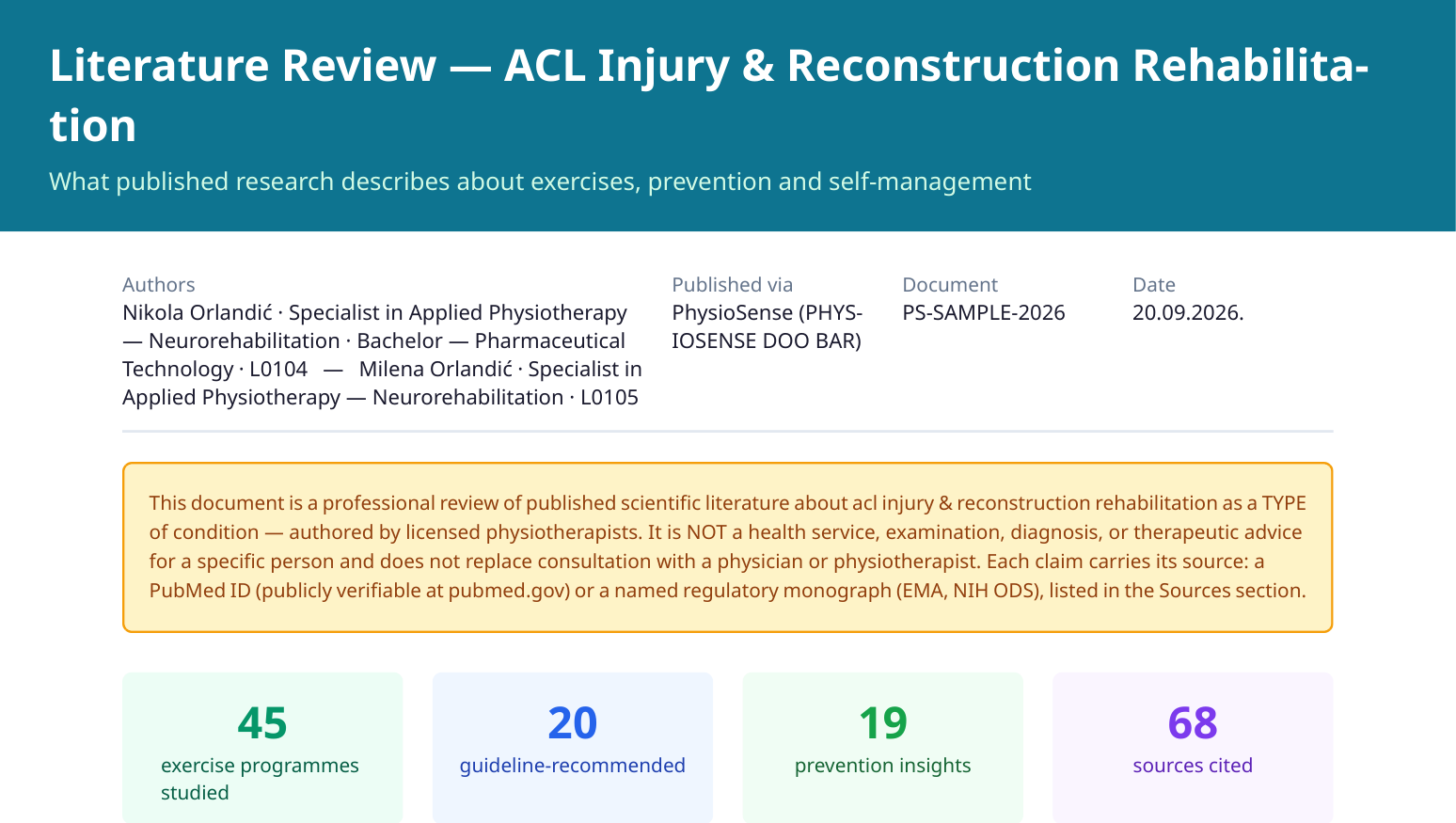
Research has examined 58 approaches for this condition. This page shows what the studies found and where clinical guidelines landed — with a source behind every claim.
Clinical guidelines support 12 of the 58 approaches studied for this condition.
Compiled and reviewed by: Nikola Orlandić — Specialist in Applied Physiotherapy — Neurorehabilitation · Bachelor — Technology, pharmaceutical module · L0104 · Milena Orlandić — Specialist in Applied Physiotherapy — Neurorehabilitation · L0105
Evidence last updated:
Partner of the Chamber of Physiotherapists of Montenegro
What studies found
Each approach below was tested in clinical research. Sorted by where clinical guidelines stand.
Closed Kinetic Chain Exercise
Evidence supports itThis systematic review identified both closed-chain (CKC) and open-chain (OKC) exercise as viable approaches for rebuilding quadriceps strength.
Source: PubMed 17940146
Exercise Therapy
Evidence supports itA large-scale trial to evaluate the effectiveness of a physiotherapist-guided exercise-therapy and education program for individuals with persistent symptoms at 1-year post-ACLR is feasible.
Source: PubMed 33430844
Neuromuscular / Motor Control Training
Evidence supports itThe Stop-X as a late-stage rehabilitation intervention might add a small, additional benefit to usual care approaches after ACL reconstruction and formal rehabilitation completion.
Source: PubMed 38479249
How these exercises and approaches were done in the studies — all in one document
Finished physiotherapy? Keep exercising live with a physiotherapist
Every programme is built on evidence-based principles and personalised only for you.
A separate online service run by licensed physiotherapists: live sessions, not recordings.
About the programme →Free first live session at the start · no minimum term
Exercises from the studies — how they were done
Which exercises, how often, for how long and how they were progressed — as published studies describe them, in one PDF document.
Delivered within 24 hours · Full refund within 14 days if the document does not contain what this page describes
What this document does not do
- It does not examine anyone or make a diagnosis.
- It does not make a plan for one person — it describes what published studies found in people with this condition.
- It does not replace a visit to a physician or a physiotherapist.
- It is written from published studies, not from your medical records.
Delivery language: the document is written in your selected language. Verbatim quotations from the source studies stay in their original language — translating them is not permitted, and it also lets you check every quote against the source.
See a sample report — ACL Injury & Reconstruction Rehabilitation (PDF) →What science does not support
These approaches are widely offered, but published research found they do not help for this condition. Listed so you know before spending money — not as advice about any individual case.
- Continuous Passive Motion (CPM)Not supported by research
van Melick 2016 (Dutch ACL Rehab CPG) · Aspetar 2023 ACL Rehab CPG
- Whole-Body VibrationNot supported by research
van Melick 2016 (Dutch ACL Rehab CPG) · Aspetar 2023 ACL Rehab CPG
Whether any of this applies to your situation is something your physiotherapist or doctor can assess after examining you.
Does it work? — what research found
Every approach studied for this condition, sorted by where clinical guidelines stand. Not by popularity or marketing — by published research.
| Approach | Studies | Reviewed by | What science says |
|---|---|---|---|
| Closed Kinetic Chain Exerciseyou can do this at homeStudies: 3 · van Melick 2016 (Dutch ACL Rehab CPG), Aspetar 2023 ACL Rehab CPG | 3 | van Melick 2016 (Dutch ACL Rehab CPG)Aspetar 2023 ACL Rehab CPG | Evidence supports it |
| Early Weight-Bearingyou can do this at homeStudies: 3 · van Melick 2016 (Dutch ACL Rehab CPG), Aspetar 2023 ACL Rehab CPG | 3 | van Melick 2016 (Dutch ACL Rehab CPG)Aspetar 2023 ACL Rehab CPG | Evidence supports it |
| Eccentric Quadriceps Exercisedone with a specialistStudies: 3 · van Melick 2016 (Dutch ACL Rehab CPG), Aspetar 2023 ACL Rehab CPG | 3 | van Melick 2016 (Dutch ACL Rehab CPG)Aspetar 2023 ACL Rehab CPG | Evidence supports it |
| Neuromuscular / Motor Control Trainingyou can do this at homeStudies: 6 · van Melick 2016 (Dutch ACL Rehab CPG), Aspetar 2023 ACL Rehab CPG | 6 | van Melick 2016 (Dutch ACL Rehab CPG)Aspetar 2023 ACL Rehab CPG | Evidence supports it |
| Neuromuscular Electrical Stimulation (NMES)done with a specialistStudies: 5 · van Melick 2016 (Dutch ACL Rehab CPG), Aspetar 2023 ACL Rehab CPG | 5 | van Melick 2016 (Dutch ACL Rehab CPG)Aspetar 2023 ACL Rehab CPG | Evidence supports it |
| Open Kinetic Chain Exerciseyou can do this at homeStudies: 4 · van Melick 2016 (Dutch ACL Rehab CPG), Aspetar 2023 ACL Rehab CPG | 4 | van Melick 2016 (Dutch ACL Rehab CPG)Aspetar 2023 ACL Rehab CPG | Evidence supports it |
| Prehabilitationyou can do this at homeStudies: 6 · van Melick 2016 (Dutch ACL Rehab CPG), Aspetar 2023 ACL Rehab CPG | 6 | van Melick 2016 (Dutch ACL Rehab CPG)Aspetar 2023 ACL Rehab CPG | Evidence supports it |
| Progressive Resistance Trainingyou can do this at homeStudies: 4 · van Melick 2016 (Dutch ACL Rehab CPG), Aspetar 2023 ACL Rehab CPG | 4 | van Melick 2016 (Dutch ACL Rehab CPG)Aspetar 2023 ACL Rehab CPG | Evidence supports it |
| Proprioceptive Trainingdone with a specialistStudies: 2 · van Melick 2016 (Dutch ACL Rehab CPG), Aspetar 2023 ACL Rehab CPG | 2 | van Melick 2016 (Dutch ACL Rehab CPG)Aspetar 2023 ACL Rehab CPG | Evidence supports it |
| Quadriceps Strengtheningyou can do this at homeStudies: 2 · van Melick 2016 (Dutch ACL Rehab CPG), Aspetar 2023 ACL Rehab CPG | 2 | van Melick 2016 (Dutch ACL Rehab CPG)Aspetar 2023 ACL Rehab CPG | Evidence supports it |
| Exercise Therapyyou can do this at homeStudies: 5 · Aspetar 2023 ACL Rehab CPG | 5 | Aspetar 2023 ACL Rehab CPG | Evidence supports it |
| Self-Efficacy Trainingdone with a specialistStudies: 1 · van Melick 2016 (Dutch ACL Rehab CPG) | 1 | van Melick 2016 (Dutch ACL Rehab CPG) | Evidence supports it |
Show all 58 approaches ↓
| Approach | Studies | Reviewed by | What science says |
|---|---|---|---|
| Cryotherapyyou can do this at homeStudies: 6 · van Melick 2016 (Dutch ACL Rehab CPG), Aspetar 2023 ACL Rehab CPG | 6 | van Melick 2016 (Dutch ACL Rehab CPG)Aspetar 2023 ACL Rehab CPG | May help |
| EMG Biofeedbackdone with a specialistStudies: 3 · van Melick 2016 (Dutch ACL Rehab CPG), Aspetar 2023 ACL Rehab CPG | 3 | van Melick 2016 (Dutch ACL Rehab CPG)Aspetar 2023 ACL Rehab CPG | May help |
| Home-Based Rehabilitationyou can do this at homeStudies: 3 · van Melick 2016 (Dutch ACL Rehab CPG), Aspetar 2023 ACL Rehab CPG | 3 | van Melick 2016 (Dutch ACL Rehab CPG)Aspetar 2023 ACL Rehab CPG | May help |
| Plyometric & Agility Trainingyou can do this at homeStudies: 2 · van Melick 2016 (Dutch ACL Rehab CPG), Aspetar 2023 ACL Rehab CPG | 2 | van Melick 2016 (Dutch ACL Rehab CPG)Aspetar 2023 ACL Rehab CPG | May help |
| Supervised Rehabilitation Trainingdone with a specialistStudies: 1 · van Melick 2016 (Dutch ACL Rehab CPG), Aspetar 2023 ACL Rehab CPG | 1 | van Melick 2016 (Dutch ACL Rehab CPG)Aspetar 2023 ACL Rehab CPG | May help |
| Aquatic Therapyyou can do this at homeStudies: 2 · Aspetar 2023 ACL Rehab CPG | 2 | Aspetar 2023 ACL Rehab CPG | May help |
| Blood Flow Restriction Trainingyou can do this at homeStudies: 8 · Aspetar 2023 ACL Rehab CPG | 8 | Aspetar 2023 ACL Rehab CPG | May help |
| Core Stability Trainingyou can do this at homeStudies: 4 · Aspetar 2023 ACL Rehab CPG | 4 | Aspetar 2023 ACL Rehab CPG | May help |
| Cycling Aerobic Trainingyou can do this at homeStudies: 1 · Aspetar 2023 ACL Rehab CPG | 1 | Aspetar 2023 ACL Rehab CPG | May help |
| Isoinertial Trainingyou can do this at homeStudies: 1 · Aspetar 2023 ACL Rehab CPG | 1 | Aspetar 2023 ACL Rehab CPG | May help |
| BMAC + PRP Augmentationdone with a specialistStudies: 2 · not yet reviewed | 2 | not yet reviewed | May help |
| Extracorporeal Shockwave Therapy (ESWT)done with a specialistStudies: 1 · not yet reviewed | 1 | not yet reviewed | May help |
| Modeling Videosdone with a specialistStudies: 2 · not yet reviewed | 2 | not yet reviewed | May help |
| Peripheral Nerve Stimulationdone with a specialistStudies: 1 · not yet reviewed | 1 | not yet reviewed | May help |
| Pilates Exercisedone with a specialistStudies: 1 · not yet reviewed | 1 | not yet reviewed | May help |
| Biofeedback Trainingdone with a specialistStudies: 2 · van Melick 2016 (Dutch ACL Rehab CPG), Aspetar 2023 ACL Rehab CPG | 2 | van Melick 2016 (Dutch ACL Rehab CPG)Aspetar 2023 ACL Rehab CPG | Not enough research yet |
| Kinesio Tapingyou can do this at homeStudies: Six studies · Aspetar 2023 ACL Rehab CPG | Six studies | Aspetar 2023 ACL Rehab CPG | Not enough research yet |
| Perturbation Trainingyou can do this at homeStudies: 5 · Aspetar 2023 ACL Rehab CPG | 5 | Aspetar 2023 ACL Rehab CPG | Not enough research yet |
| Treadmill Walking Trainingyou can do this at homeStudies: 1 · Aspetar 2023 ACL Rehab CPG | 1 | Aspetar 2023 ACL Rehab CPG | Not enough research yet |
| Visual Feedback Balance Trainingdone with a specialistStudies: 1 · Aspetar 2023 ACL Rehab CPG | 1 | Aspetar 2023 ACL Rehab CPG | Not enough research yet |
| Accelerated Rehabilitationyou can do this at homeStudies: 1 · not yet reviewed | 1 | not yet reviewed | Not enough research yet |
| Cognitive-Behavioral Physical Therapydone with a specialistStudies: 1 · not yet reviewed | 1 | not yet reviewed | Not enough research yet |
| Conservative Management (Non-surgical)you can do this at homeStudies: 3 · not yet reviewed | 3 | not yet reviewed | Not enough research yet |
| Digital Structured Educationdone with a specialistStudies: 1 · not yet reviewed | 1 | not yet reviewed | Not enough research yet |
| Elastic Resistance Band Trainingyou can do this at homeStudies: 1 · not yet reviewed | 1 | not yet reviewed | Not enough research yet |
| Exercise + Cryotherapydone with a specialistStudies: 1 · not yet reviewed | 1 | not yet reviewed | Not enough research yet |
| Exercise + TENSdone with a specialistStudies: 1 · not yet reviewed | 1 | not yet reviewed | Not enough research yet |
| Functional Knee Bracedone with a specialistStudies: 2 · not yet reviewed | 2 | not yet reviewed | Not enough research yet |
| Guided Imagerydone with a specialistStudies: 1 · not yet reviewed | 1 | not yet reviewed | Not enough research yet |
| In Vivo Exposure Therapydone with a specialistStudies: 1 · not yet reviewed | 1 | not yet reviewed | Not enough research yet |
| Interferential Current Therapy (IFC)done with a specialistStudies: 1 · not yet reviewed | 1 | not yet reviewed | Not enough research yet |
| Internet-Delivered Psychological Supportdone with a specialistStudies: 1 · not yet reviewed | 1 | not yet reviewed | Not enough research yet |
| Motor Imagerydone with a specialistStudies: 1 · not yet reviewed | 1 | not yet reviewed | Not enough research yet |
| Myofascial Release / Mobilizationdone with a specialistStudies: 1 · not yet reviewed | 1 | not yet reviewed | Not enough research yet |
| Nordic Hamstring Exercisedone with a specialistStudies: 1 · not yet reviewed | 1 | not yet reviewed | Not enough research yet |
| Percussion Massage Therapydone with a specialistStudies: 1 · not yet reviewed | 1 | not yet reviewed | Not enough research yet |
| Platelet-Rich Plasma (PRP)done with a specialistStudies: 3 · not yet reviewed | 3 | not yet reviewed | Not enough research yet |
| RegentK Manual Therapydone with a specialistStudies: 1 · not yet reviewed | 1 | not yet reviewed | Not enough research yet |
| Robotic-Assisted Rehabilitationdone with a specialistStudies: 1 · not yet reviewed | 1 | not yet reviewed | Not enough research yet |
| SAP + Perturbation Trainingyou can do this at homeStudies: 1 · not yet reviewed | 1 | not yet reviewed | Not enough research yet |
| TENSdone with a specialistStudies: 2 · not yet reviewed | 2 | not yet reviewed | Not enough research yet |
| Virtual Reality Rehabilitationdone with a specialistStudies: 1 · not yet reviewed | 1 | not yet reviewed | Not enough research yet |
| Continuous Passive Motion (CPM)done with a specialistStudies: 3 · van Melick 2016 (Dutch ACL Rehab CPG), Aspetar 2023 ACL Rehab CPG | 3 | van Melick 2016 (Dutch ACL Rehab CPG)Aspetar 2023 ACL Rehab CPG | Science does not support it |
| Whole-Body Vibrationdone with a specialistStudies: Six studies · van Melick 2016 (Dutch ACL Rehab CPG), Aspetar 2023 ACL Rehab CPG | Six studies | van Melick 2016 (Dutch ACL Rehab CPG)Aspetar 2023 ACL Rehab CPG | Science does not support it |
| Cross-Education / Bilateral Trainingyou can do this at homeStudies: 1 · Aspetar 2023 ACL Rehab CPG | 1 | Aspetar 2023 ACL Rehab CPG | Science does not support itdepends on the stage of recovery |
| Dry Needlingdone with a specialistStudies: One study · Aspetar 2023 ACL Rehab CPG | One study | Aspetar 2023 ACL Rehab CPG | Science does not support itdepends on the stage of recovery |
Prevention
Factors that published studies link to higher or lower risk for this condition.
Balance & Proprioception Training
Shown in prevention studiesThis study found that when balance training formed part of a programme, the overall ACL injury rate per 1,000 exposure hours fell by 58% (IRR 0.42, 95% CI: 0.27 to 0.66).
Source: PubMed 40051003
Knaecontrol Program
Shown in prevention studiesThis RCT observed that the intervention group experienced a 64% lower rate of anterior cruciate ligament injury (rate ratio 0.36, 95% confidence interval 0.15 to 0.85).
Source: PubMed 22556050
Neuromuscular Training Programs
Shown in prevention studiesThis RCT reported that, among adolescent female football players, a 15 minute neuromuscular warm-up lowered the overall anterior cruciate ligament injury rate by 64%.
Source: PubMed 22556050
Show all 19 prevention factors ↓
Plyometric Training
Shown in prevention studiesPooling across trials, this study found that adding plyometric drills to prevention programs cut ACL injury risk by 60% for every 1,000 hours of exposure relative to controls (injury risk ratio 0.40, 95% CI 0.26 to 0.63).
Source: PubMed 36244964
Strength Training
Shown in prevention studiesDrawing on four studies, this pooled analysis reported a strength-training estimate of RR 0.315 (0.207–0.480, I2=0%, χ2 p=0.808).
Source: PubMed 24100287
Biomechanical Risk Factors
Risk factor in studiesThis study describes stronger gluteus maximus as potentially protective against future ACL injury, whereas an elevated body mass index emerges as a risk factor for such injury.
Source: PubMed 40356533
Biomechanical Screening
Risk factor in studiesThis study reported that ROC analysis produced an area under the curve of 0.6, reflecting poor-to-failed combined sensitivity and specificity for the test.
Source: PubMed 26867936
BMI & Body Composition
Risk factor in studiesThis study found that among women whose BMI sat at least 1 SD above the mean, the relative risk of noncontact ACL injury reached 3.5 times that seen in women with lower BMI.
Source: PubMed 14623646
Coach Education & Implementation Support
Risk factor in studiesA systematic review of neuromuscular training implementation found that stakeholder-engaged models with professional support achieved higher compliance (73.5-85.6%) than education-only approaches.
Source: PubMed 41815969
Fatigue Management
Risk factor in studiesAmong the 14 kinematic variables reviewed, strong evidence indicates increased knee internal rotation angles at peak vertical ground reaction force (vGRF) during landing tasks after the knee flexors and extensors peripheral fatigue protocols (Effect size = 0.24–0.68).
Source: PubMed 40567252
FIFA 11+ Warm-Up Program
Shown in prevention studiesThis study points to a structured warm-up programme as capable of preventing injuries in young female football players.
Source: PubMed 19066253
Hamstring:Quadriceps Strength Ratio
Risk factor in studiesThis study's best-evidence synthesis found only very limited support for the H:Q strength ratio as an independent risk factor in hamstring and ACL injury, a finding that held across the different ratio types.
Source: PubMed 35065297
HarmoKnee Program
Shown in prevention studiesThis study describes how knee-injury incidence in young female soccer players may be lowered by rolling out a multifaceted, soccer-specific exercise programme that also educates each player.
Source: PubMed 20065198
Hip Strengthening
Risk factor in studiesThis study linked weaker hip strength to a higher risk of future injury (external rotation: OR = 1.23 [95% CI, 1.08-1.39], P = .001; abduction: OR = 1.12 [95% CI, 1.05-1.20], P = .001).
Source: PubMed 26646514
PEP (Prevent Injury Enhance Performance)
Shown in prevention studiesThis study reported that swapping in a warm-up centred on specific neuromuscular and proprioceptive drills - the PEP Program - may cut the risk of noncontact ACL injuries among collegiate female soccer players.
Source: PubMed 18658019
Physical Activity Level
Risk factor in studiesAccording to this study, once socioeconomic, health, and lifestyle factors were accounted for, subjects taking part in organised sports >4 times/week carried an adjusted hazard ratio for knee cruciate ligament injury of 8.5 (95% CI 4.3 to 16.4) among women and 4.0 (95% CI 2.7 to 6.1) among men.
Source: PubMed 18390920
Psychological Readiness & Kinesiophobia Screening
Risk factor in studiesPatients with a TSK-11 score of ≥19 at the time of RTS were found to be 13 times more likely to suffer a second ACL tear
Source: PubMed 39041333
Sport Exposure & Training Load
Risk factor in studiesAt all skill levels, match incidence (professional: 0.343; semi-professional: 0.249; amateur: 0.319) was significantly higher than training incidence (professional: 0.015; semi-professional: 0.004; amateur: 0.005).
Source: PubMed 34524500
Sportsmetrics Program
Shown in prevention studiesyoung female athletes in sports that entail jumping, pivoting, and cutting, such as basketball, volleyball, and soccer, be trained before participation with a proven effective jump training program that includes progressive resistance weight training for the lower extremity
Source: PubMed 10569353
Frequently asked
What works for ACL Injury & Reconstruction Rehabilitation according to research?
Research supports: Closed Kinetic Chain Exercise, Early Weight-Bearing, Eccentric Quadriceps Exercise, Neuromuscular / Motor Control Training, Neuromuscular Electrical Stimulation (NMES), Open Kinetic Chain Exercise. Based on van Melick 2016 (Dutch ACL Rehab CPG); Aspetar 2023 ACL Rehab CPG.
What does not work for ACL Injury & Reconstruction Rehabilitation according to research?
Research found no benefit from routine use of: Continuous Passive Motion (CPM), Whole-Body Vibration. Based on van Melick 2016 (Dutch ACL Rehab CPG); Aspetar 2023 ACL Rehab CPG.
How much research is this based on?
For ACL Injury & Reconstruction Rehabilitation, 58 approaches were evaluated, of which 31 have been reviewed by research bodies. Every data point traces to a published source.
Why do so many approaches say 'not enough research yet'?
Because that is the honest state of the research. 'Not enough research yet' means clinical guidelines have not taken a clear position, or few controlled trials exist for that approach. This page shows the entire landscape — not only the flattering rows.
What if the exercises don't lead to improvement?
Studies report results at the population level — individual responses vary. The literature also describes signs that call for a medical check (listed under 'When to see a doctor'), and a clinician is the right address for an individual assessment.
🚩 When to see a doctor
Some symptoms call for a medical check before any exercise: severe pain after an injury, numbness or tingling, weakness, fever with pain, night pain that does not ease, or bladder/bowel changes. If any of these are present, see a doctor first.
More safety signs →Healthcare professional?
The professional platform adds full source traceability — every data point leads to the exact study page.
Educational Information — PhysioSense is an educational reference tool based on published research. It does NOT replace a medical examination or physiotherapy assessment. If you have severe pain, new symptoms, or are unsure — see a doctor or physiotherapist. You always make the final decision about your exercise. Pain is a signal to stop.