Knee Osteoarthritis — Exercises Studied in Research
Research has examined 53 approaches for this condition. This page shows what the studies found and where clinical guidelines landed — with a source behind every claim.
Clinical guidelines support 11 of the 53 approaches studied for this condition.
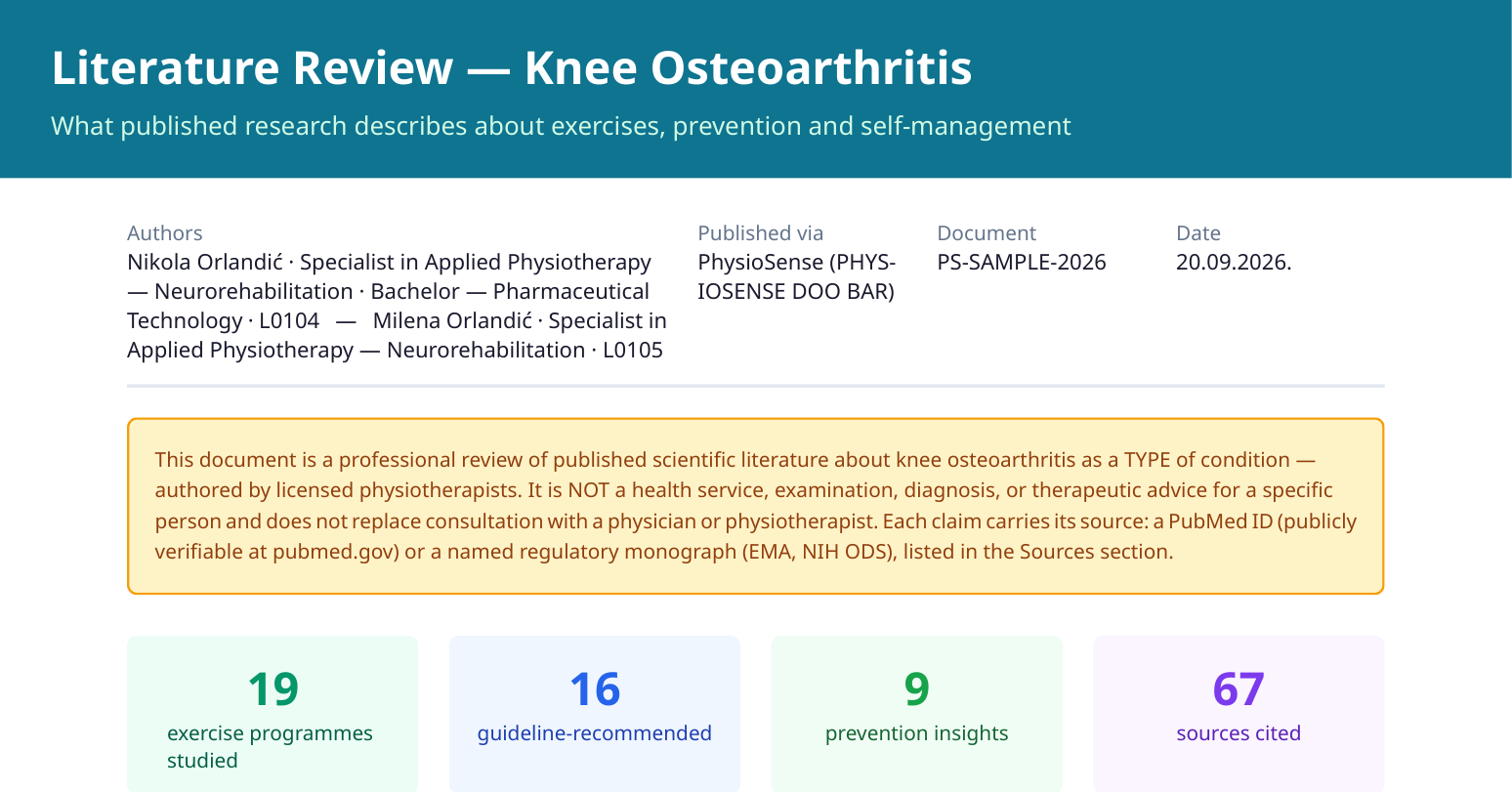
Compiled and reviewed by: Nikola Orlandić — Specialist in Applied Physiotherapy — Neurorehabilitation · Bachelor — Technology, pharmaceutical module · L0104 · Milena Orlandić — Specialist in Applied Physiotherapy — Neurorehabilitation · L0105
Evidence last updated:
Partner of the Chamber of Physiotherapists of Montenegro
What studies found
Each approach below was tested in clinical research. Sorted by where clinical guidelines stand.
Cycling
Evidence supports itHigh-intensity stationary cycling can significantly improve glycemic control compared with moderate-intensity and regular rehabilitation programs, but does not exert a superior effect on pain relief and functional improvement for KOA
Evidence base: 1 · Source: PubMed 39286270
Flexibility Exercise
Evidence supports itboth approaches are significantly and equally effective in knee OA treatment. There is no one of dynamic soft tissue mobilization and PNF stretching is more beneficial than to another in reduction of hamstring tightness, decreasing pain intensity, and functional mobility improvement in knee osteoarthritis
Source: PubMed 37268961
Patient Education
Evidence supports itEducation and supervised exercise delivered nationwide in Denmark in clinical practice through GLA:D appeared to improve pain, physical function, physical activity and quality of life and reduce the number of patients taking painkillers and being on sick leave.
Source: PubMed 28173795
How these exercises and approaches were done in the studies — all in one document
Finished physiotherapy? Keep exercising live with a physiotherapist
Every programme is built on evidence-based principles and personalised only for you.
A separate online service run by licensed physiotherapists: live sessions, not recordings.
About the programme →Free first live session at the start · no minimum term
Exercises from the studies — how they were done
Which exercises, how often, for how long and how they were progressed — as published studies describe them, in one PDF document.
Delivered within 24 hours · Full refund within 14 days if the document does not contain what this page describes
What this document does not do
- It does not examine anyone or make a diagnosis.
- It does not make a plan for one person — it describes what published studies found in people with this condition.
- It does not replace a visit to a physician or a physiotherapist.
- It is written from published studies, not from your medical records.
Delivery language: the document is written in your selected language. Verbatim quotations from the source studies stay in their original language — translating them is not permitted, and it also lets you check every quote against the source.
See a sample report — Knee Osteoarthritis (PDF) →What science does not support
These approaches are widely offered, but published research found they do not help for this condition. Listed so you know before spending money — not as advice about any individual case.
- GlucosamineNot supported by research
NICE NG226 2022 — Osteoarthritis in over 16s · Beating osteoARThritis: stepped care strategy (Smink 2011) · ACR/AF 2020 (Kolasinski)
- OpioidsNot supported by research
NICE NG226 2022 — Osteoarthritis in over 16s · OARSI 2019 (Bannuru) · ACR/AF 2020 (Kolasinski)
- Stem Cell TherapyNot supported by research
NICE NG226 2022 — Osteoarthritis in over 16s · OARSI 2019 (Bannuru) · ACR/AF 2020 (Kolasinski)
- TENS / ElectrotherapyNot supported by research
NICE NG226 2022 — Osteoarthritis in over 16s · Beating osteoARThritis: stepped care strategy (Smink 2011) · ACR/AF 2020 (Kolasinski)
- Laser Therapy / LLLTNot supported by research
NICE NG226 2022 — Osteoarthritis in over 16s · OARSI 2019 (Bannuru)
- Massage TherapyNot supported by research
OARSI 2019 (Bannuru) · ACR/AF 2020 (Kolasinski)
- Platelet-Rich Plasma (PRP)Not supported by research
OARSI 2019 (Bannuru) · ACR/AF 2020 (Kolasinski)
- Arthroscopy / Arthroscopic SurgeryNot supported by research
NICE NG226 2022 — Osteoarthritis in over 16s
- Chondroitin SulfateNot supported by research
ACR/AF 2020 (Kolasinski)
- Dry NeedlingNot supported by research
NICE NG226 2022 — Osteoarthritis in over 16s
- Interferential CurrentNot supported by research
NICE NG226 2022 — Osteoarthritis in over 16s
- Neuromuscular Electrical Stimulation (NMES)Not supported by research
NICE NG226 2022 — Osteoarthritis in over 16s
- Pulsed VibrationNot supported by research
ACR/AF 2020 (Kolasinski)
- Shortwave DiathermyNot supported by research
NICE NG226 2022 — Osteoarthritis in over 16s
- Therapeutic UltrasoundNot supported by research
NICE NG226 2022 — Osteoarthritis in over 16s
- Vitamin DNot supported by research
ACR/AF 2020 (Kolasinski)
Whether any of this applies to your situation is something your physiotherapist or doctor can assess after examining you.
Does it work? — what research found
Every approach studied for this condition, sorted by where clinical guidelines stand. Not by popularity or marketing — by published research.
| Approach | Studies | Reviewed by | What science says |
|---|---|---|---|
| Exercise Therapy (Combined Programs)done with a specialistStudies: 44 · NICE NG226 2022 — Osteoarthritis in over 16s, Beating osteoARThritis: stepped care strategy (Smink 2011) +3 | 44 | NICE NG226 2022 — Osteoarthritis in over 16sBeating osteoARThritis: stepped care strategy (Smink 2011) +3 | Evidence supports it |
| Weight Managementyou can do this at homeStudies: 6 · NICE NG226 2022 — Osteoarthritis in over 16s, Beating osteoARThritis: stepped care strategy (Smink 2011) +3 | 6 | NICE NG226 2022 — Osteoarthritis in over 16sBeating osteoARThritis: stepped care strategy (Smink 2011) +3 | Evidence supports it |
| NSAIDs (Topical)done with a specialistStudies: 4 studies (for pain at 3-6 weeks); 2 studies (for function at 8-12 weeks) · Beating osteoARThritis: stepped care strategy (Smink 2011), OARSI 2019 (Bannuru) +1 | 4 studies (for pain at 3-6 weeks); 2 studies (for function at 8-12 weeks) | Beating osteoARThritis: stepped care strategy (Smink 2011)OARSI 2019 (Bannuru) +1 | Evidence supports it |
| Patient Educationyou can do this at homeStudies: 9 · Beating osteoARThritis: stepped care strategy (Smink 2011), OARSI 2019 (Bannuru) +1 | 9 | Beating osteoARThritis: stepped care strategy (Smink 2011)OARSI 2019 (Bannuru) +1 | Evidence supports it |
| Self Managementyou can do this at homeStudies: 5 · OARSI 2019 (Bannuru), ACR/AF 2020 (Kolasinski) +1 | 5 | OARSI 2019 (Bannuru)ACR/AF 2020 (Kolasinski) +1 | Evidence supports it |
| Tai Chiyou can do this at homeStudies: 7 · OARSI 2019 (Bannuru), ACR/AF 2020 (Kolasinski) +1 | 7 | OARSI 2019 (Bannuru)ACR/AF 2020 (Kolasinski) +1 | Evidence supports it |
| Yogayou can do this at homeStudies: 3 · OARSI 2019 (Bannuru), ACR/AF 2020 (Kolasinski) +1 | 3 | OARSI 2019 (Bannuru)ACR/AF 2020 (Kolasinski) +1 | Evidence supports it |
| NSAIDs (General)done with a specialistStudies: 1 · Beating osteoARThritis: stepped care strategy (Smink 2011), OARSI 2019 (Bannuru) | 1 | Beating osteoARThritis: stepped care strategy (Smink 2011)OARSI 2019 (Bannuru) | Evidence supports it |
| Cyclingyou can do this at homeStudies: 1 · EULAR 2024 (Moseng) | 1 | EULAR 2024 (Moseng) | Evidence supports it |
| Flexibility Exerciseyou can do this at homeStudies: 2 · EULAR 2024 (Moseng) | 2 | EULAR 2024 (Moseng) | Evidence supports it |
| Quadriceps Strengtheningyou can do this at homeStudies: 9 · EULAR 2024 (Moseng) | 9 | EULAR 2024 (Moseng) | Evidence supports it |
| Aquatic Exerciseyou can do this at homeStudies: 5 · OARSI 2019 (Bannuru), ACR/AF 2020 (Kolasinski) +1 | 5 | OARSI 2019 (Bannuru)ACR/AF 2020 (Kolasinski) +1 | May help |
Show all 53 approaches ↓
| Approach | Studies | Reviewed by | What science says |
|---|---|---|---|
| Cognitive Behavioral Therapydone with a specialistStudies: 4 · OARSI 2019 (Bannuru), ACR/AF 2020 (Kolasinski) +1 | 4 | OARSI 2019 (Bannuru)ACR/AF 2020 (Kolasinski) +1 | May help |
| Intra-articular Corticosteroiddone with a specialistStudies: 7 · Beating osteoARThritis: stepped care strategy (Smink 2011), OARSI 2019 (Bannuru) +1 | 7 | Beating osteoARThritis: stepped care strategy (Smink 2011)OARSI 2019 (Bannuru) +1 | May help |
| Manual Therapydone with a specialistStudies: 5 · NICE NG226 2022 — Osteoarthritis in over 16s, OARSI 2019 (Bannuru) +1 | 5 | NICE NG226 2022 — Osteoarthritis in over 16sOARSI 2019 (Bannuru) +1 | May help |
| Aerobic Exerciseyou can do this at homeStudies: 11 · ACR/AF 2020 (Kolasinski), EULAR 2024 (Moseng) | 11 | ACR/AF 2020 (Kolasinski)EULAR 2024 (Moseng) | May help |
| Duloxetine (SNRI)done with a specialistStudies: 6 · OARSI 2019 (Bannuru), ACR/AF 2020 (Kolasinski) | 6 | OARSI 2019 (Bannuru)ACR/AF 2020 (Kolasinski) | May help |
| Heat Therapyyou can do this at homeStudies: 4 · OARSI 2019 (Bannuru), ACR/AF 2020 (Kolasinski) | 4 | OARSI 2019 (Bannuru)ACR/AF 2020 (Kolasinski) | May help |
| NSAIDs (Oral)done with a specialistStudies: 7 · OARSI 2019 (Bannuru), ACR/AF 2020 (Kolasinski) | 7 | OARSI 2019 (Bannuru)ACR/AF 2020 (Kolasinski) | May help |
| Tapingyou can do this at homeStudies: 1 · OARSI 2019 (Bannuru), ACR/AF 2020 (Kolasinski) | 1 | OARSI 2019 (Bannuru)ACR/AF 2020 (Kolasinski) | May help |
| Cold Therapyyou can do this at homeStudies: 2 · ACR/AF 2020 (Kolasinski) | 2 | ACR/AF 2020 (Kolasinski) | May help |
| Total Knee Arthroplasty (TKA)done with a specialistStudies: 1 · NICE NG226 2022 — Osteoarthritis in over 16s | 1 | NICE NG226 2022 — Osteoarthritis in over 16s | May help |
| Pulsed Electromagnetic Field Therapy (PEMF)done with a specialistStudies: 2 · not yet reviewed | 2 | not yet reviewed | May help |
| Paracetamol / Acetaminophendone with a specialistStudies: 2 · NICE NG226 2022 — Osteoarthritis in over 16s, Beating osteoARThritis: stepped care strategy (Smink 2011) +2 | 2 | NICE NG226 2022 — Osteoarthritis in over 16sBeating osteoARThritis: stepped care strategy (Smink 2011) +2 | Not enough research yet |
| Acupuncturedone with a specialistStudies: 2 · NICE NG226 2022 — Osteoarthritis in over 16s, ACR/AF 2020 (Kolasinski) | 2 | NICE NG226 2022 — Osteoarthritis in over 16sACR/AF 2020 (Kolasinski) | Not enough research yet |
| Knee Brace / Unloader Bracedone with a specialistStudies: 3 · OARSI 2019 (Bannuru), ACR/AF 2020 (Kolasinski) | 3 | OARSI 2019 (Bannuru)ACR/AF 2020 (Kolasinski) | Not enough research yet |
| Topical Capsaicindone with a specialistStudies: three systematic reviews · OARSI 2019 (Bannuru), ACR/AF 2020 (Kolasinski) | three systematic reviews | OARSI 2019 (Bannuru)ACR/AF 2020 (Kolasinski) | Not enough research yet |
| Acupuncture + Exercise Trainingdone with a specialistStudies: 1 · not yet reviewed | 1 | not yet reviewed | Not enough research yet |
| Corticosteroid Injectiondone with a specialistStudies: 2 · not yet reviewed | 2 | not yet reviewed | Not enough research yet |
| Electroacupuncturedone with a specialistStudies: 2 · not yet reviewed | 2 | not yet reviewed | Not enough research yet |
| Extracorporeal Shockwave Therapy (ESWT)done with a specialistStudies: 3 · not yet reviewed | 3 | not yet reviewed | Not enough research yet |
| GLA:D® Program (Good Life with osteoArthritis from Denmark)done with a specialistStudies: 2 · not yet reviewed | 2 | not yet reviewed | Not enough research yet |
| Manual Therapy + Exercisedone with a specialistStudies: 1 · not yet reviewed | 1 | not yet reviewed | Not enough research yet |
| Osteotomy (High Tibial)done with a specialistStudies: 3 · not yet reviewed | 3 | not yet reviewed | Not enough research yet |
| Pilatesdone with a specialistStudies: 3 · not yet reviewed | 3 | not yet reviewed | Not enough research yet |
| TECAR Therapy (Capacitive/Resistive Diathermy)done with a specialistStudies: 2 · not yet reviewed | 2 | not yet reviewed | Not enough research yet |
| Hyaluronic Acid (Viscosupplementation)done with a specialistStudies: 14 · NICE NG226 2022 — Osteoarthritis in over 16s, Beating osteoARThritis: stepped care strategy (Smink 2011) +2 | 14 | NICE NG226 2022 — Osteoarthritis in over 16sBeating osteoARThritis: stepped care strategy (Smink 2011) +2 | Science does not support itdepends on the stage of recovery |
| Glucosaminedone with a specialistStudies: 79 studies for pain, 55 studies for function (NMA total) · NICE NG226 2022 — Osteoarthritis in over 16s, Beating osteoARThritis: stepped care strategy (Smink 2011) +1 | 79 studies for pain, 55 studies for function (NMA total) | NICE NG226 2022 — Osteoarthritis in over 16sBeating osteoARThritis: stepped care strategy (Smink 2011) +1 | Science does not support it |
| Opioidsdone with a specialistStudies: 5 · NICE NG226 2022 — Osteoarthritis in over 16s, OARSI 2019 (Bannuru) +1 | 5 | NICE NG226 2022 — Osteoarthritis in over 16sOARSI 2019 (Bannuru) +1 | Science does not support it |
| Stem Cell Therapydone with a specialistStudies: 6 · NICE NG226 2022 — Osteoarthritis in over 16s, OARSI 2019 (Bannuru) +1 | 6 | NICE NG226 2022 — Osteoarthritis in over 16sOARSI 2019 (Bannuru) +1 | Science does not support it |
| TENS / Electrotherapydone with a specialistStudies: 6 · NICE NG226 2022 — Osteoarthritis in over 16s, Beating osteoARThritis: stepped care strategy (Smink 2011) +1 | 6 | NICE NG226 2022 — Osteoarthritis in over 16sBeating osteoARThritis: stepped care strategy (Smink 2011) +1 | Science does not support it |
| Laser Therapy / LLLTdone with a specialistStudies: 3 · NICE NG226 2022 — Osteoarthritis in over 16s, OARSI 2019 (Bannuru) | 3 | NICE NG226 2022 — Osteoarthritis in over 16sOARSI 2019 (Bannuru) | Science does not support it |
| Massage Therapydone with a specialistStudies: 1 · OARSI 2019 (Bannuru), ACR/AF 2020 (Kolasinski) | 1 | OARSI 2019 (Bannuru)ACR/AF 2020 (Kolasinski) | Science does not support it |
| Platelet-Rich Plasma (PRP)done with a specialistStudies: 18 RCTs included · OARSI 2019 (Bannuru), ACR/AF 2020 (Kolasinski) | 18 RCTs included | OARSI 2019 (Bannuru)ACR/AF 2020 (Kolasinski) | Science does not support it |
| Arthroscopy / Arthroscopic Surgerydone with a specialistStudies: 6 · NICE NG226 2022 — Osteoarthritis in over 16s | 6 | NICE NG226 2022 — Osteoarthritis in over 16s | Science does not support it |
| Chondroitin Sulfatedone with a specialistStudies: 21 · ACR/AF 2020 (Kolasinski) | 21 | ACR/AF 2020 (Kolasinski) | Science does not support it |
| Dry Needlingdone with a specialistStudies: 1 · NICE NG226 2022 — Osteoarthritis in over 16s | 1 | NICE NG226 2022 — Osteoarthritis in over 16s | Science does not support it |
| Interferential Currentdone with a specialistStudies: 2 · NICE NG226 2022 — Osteoarthritis in over 16s | 2 | NICE NG226 2022 — Osteoarthritis in over 16s | Science does not support it |
| Neuromuscular Electrical Stimulation (NMES)done with a specialistStudies: 2 · NICE NG226 2022 — Osteoarthritis in over 16s | 2 | NICE NG226 2022 — Osteoarthritis in over 16s | Science does not support it |
| Pulsed Vibrationdone with a specialistStudies: 1 · ACR/AF 2020 (Kolasinski) | 1 | ACR/AF 2020 (Kolasinski) | Science does not support it |
| Shortwave Diathermydone with a specialistStudies: 1 · NICE NG226 2022 — Osteoarthritis in over 16s | 1 | NICE NG226 2022 — Osteoarthritis in over 16s | Science does not support it |
| Therapeutic Ultrasounddone with a specialistStudies: 5 · NICE NG226 2022 — Osteoarthritis in over 16s | 5 | NICE NG226 2022 — Osteoarthritis in over 16s | Science does not support it |
| Vitamin Ddone with a specialistStudies: 79 studies for pain, 55 studies for function (NMA total) · ACR/AF 2020 (Kolasinski) | 79 studies for pain, 55 studies for function (NMA total) | ACR/AF 2020 (Kolasinski) | Science does not support it |
Prevention
Factors that published studies link to higher or lower risk for this condition.
Injury Prevention (ACL, Meniscus Protection)
Shown in prevention studiesThis RCT found that a neuromuscular warm-up routine produced a significant drop in anterior cruciate ligament injury rates among adolescent girls playing football.
Source: PubMed 22556050
Fall Prevention in Elderly with OA
Risk factor in studiesThis review describes Type 1 structured land-based exercise programmes, spanning strengthening, cardiovascular, and balance/neuromuscular training.
Source: PubMed 31278997
Footwear Modification
Risk factor in studiesThe guideline describes benefit from stable, supportive shoes rather than flat, flexible ones, worn for a minimum of 6 hours daily.
Source: PubMed 38212040
Show all 9 prevention factors ↓
Joint Protection Strategies
Risk factor in studiesconsider walking aids, appropriate footwear, assistive devices
Source: PubMed 38212040
Occupational Risk Reduction (Kneeling, Squatting)
Risk factor in studiesEvidence associates longer cumulative occupational exposure to kneeling or squatting at work with a higher risk of knee osteoarthritis.
Source: PubMed 28593068
Physical Activity Guidelines (Moderate-Intensity)
Risk factor in studiesPer the guideline, exercise programming may span strength, aerobic, flexibility, or neuromotor domains.
Source: PubMed 38212040
Previous Knee Injury (Risk Factor)
Risk factor in studiesEvidence associates previous knee injury with an almost three-fold increased odds of incident radiographic knee osteoarthritis (OR 2.67, 95% CI 1.41-5.05).
Source: PubMed 40174718
Quadriceps Strengthening (Primary Prevention)
Risk factor in studiesThis review describes Type 1 structured land-based exercise programmes, spanning strengthening, cardiovascular, and balance/neuromuscular training.
Source: PubMed 31278997
Weight Reduction (BMI < 25)
Risk factor in studiesThis guideline describes core treatments for knee OA as including arthritis education and structured land-based exercise programs, with or without dietary weight management.
Source: PubMed 31278997
Frequently asked
What works for Knee Osteoarthritis according to research?
Research supports: Exercise Therapy (Combined Programs), Weight Management, NSAIDs (Topical), Patient Education, Self Management, Tai Chi. Based on NICE NG226 2022 — Osteoarthritis in over 16s; Beating osteoARThritis: stepped care strategy (Smink 2011); OARSI 2019 (Bannuru).
What does not work for Knee Osteoarthritis according to research?
Research found no benefit from routine use of: Glucosamine, Opioids, Stem Cell Therapy, TENS / Electrotherapy, Laser Therapy / LLLT, Massage Therapy. Based on NICE NG226 2022 — Osteoarthritis in over 16s; Beating osteoARThritis: stepped care strategy (Smink 2011); ACR/AF 2020 (Kolasinski).
How much research is this based on?
For Knee Osteoarthritis, 53 approaches were evaluated, of which 43 have been reviewed by research bodies. Every data point traces to a published source.
Why do so many approaches say 'not enough research yet'?
Because that is the honest state of the research. 'Not enough research yet' means clinical guidelines have not taken a clear position, or few controlled trials exist for that approach. This page shows the entire landscape — not only the flattering rows.
What if the exercises don't lead to improvement?
Studies report results at the population level — individual responses vary. The literature also describes signs that call for a medical check (listed under 'When to see a doctor'), and a clinician is the right address for an individual assessment.
🚩 When to see a doctor
Some symptoms call for a medical check before any exercise: severe pain after an injury, numbness or tingling, weakness, fever with pain, night pain that does not ease, or bladder/bowel changes. If any of these are present, see a doctor first.
More safety signs →Healthcare professional?
The professional platform adds full source traceability — every data point leads to the exact study page.
Educational Information — PhysioSense is an educational reference tool based on published research. It does NOT replace a medical examination or physiotherapy assessment. If you have severe pain, new symptoms, or are unsure — see a doctor or physiotherapist. You always make the final decision about your exercise. Pain is a signal to stop.