Non-Specific Neck Pain — Exercises Studied in Research
Research has examined 42 approaches for this condition. This page shows what the studies found and where clinical guidelines landed — with a source behind every claim.
Clinical guidelines support 5 of the 42 approaches studied for this condition.
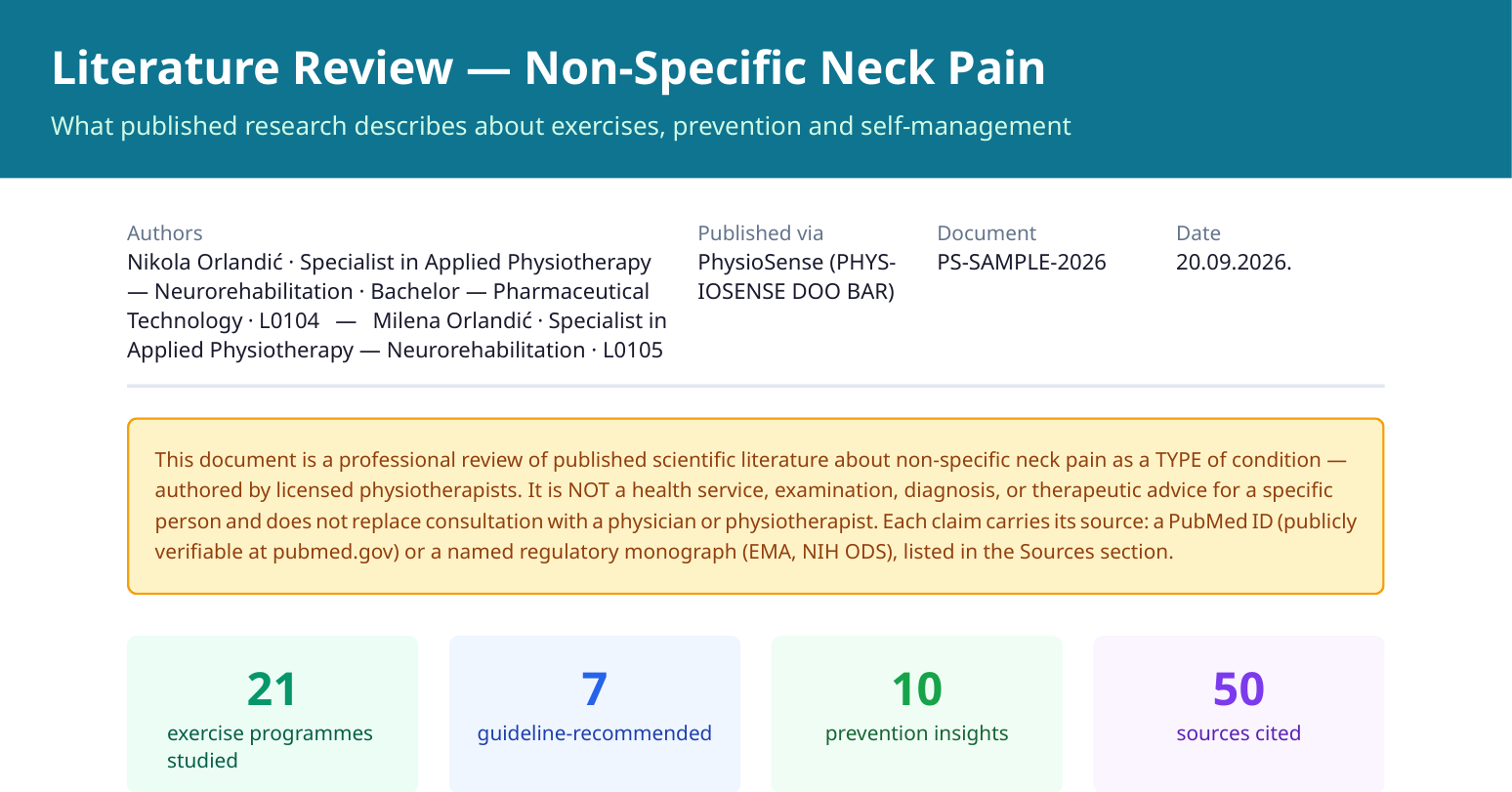
Compiled and reviewed by: Nikola Orlandić — Specialist in Applied Physiotherapy — Neurorehabilitation · Bachelor — Technology, pharmaceutical module · L0104 · Milena Orlandić — Specialist in Applied Physiotherapy — Neurorehabilitation · L0105
Evidence last updated:
Partner of the Chamber of Physiotherapists of Montenegro
What studies found
Each approach below was tested in clinical research. Sorted by where clinical guidelines stand.
Chin Tucks / Deep Cervical Flexor Training
Evidence supports itThis RCT found that, in chronic neck pain, combining DNF and scapulothoracic exercises with conventional physiotherapy, and likewise combining McKenzie exercises with conventional physiotherapy, both improved cervical mobility and lowered pain intensity and disability more than conventional physiotherapy alone.
Source: PubMed 35587064
General Exercise Program
Evidence supports itthis study has demonstrated the safety and feasibility for tDCS + ET providing strong support to proceed with a larger, adequately powered, clinical trial
Source: PubMed 39825590
Isometric / Resistance Neck Exercises
Evidence supports itas little as 2 minutes of daily progressive resistance training for 10 weeks results in clinically relevant reductions of pain and tenderness in healthy adults with frequent neck/shoulder symptoms
Source: PubMed 21177034
How these exercises and approaches were done in the studies — all in one document
Finished physiotherapy? Keep exercising live with a physiotherapist
Every programme is built on evidence-based principles and personalised only for you.
A separate online service run by licensed physiotherapists: live sessions, not recordings.
About the programme →Free first live session at the start · no minimum term
Exercises from the studies — how they were done
Which exercises, how often, for how long and how they were progressed — as published studies describe them, in one PDF document.
Delivered within 24 hours · Full refund within 14 days if the document does not contain what this page describes
What this document does not do
- It does not examine anyone or make a diagnosis.
- It does not make a plan for one person — it describes what published studies found in people with this condition.
- It does not replace a visit to a physician or a physiotherapist.
- It is written from published studies, not from your medical records.
Delivery language: the document is written in your selected language. Verbatim quotations from the source studies stay in their original language — translating them is not permitted, and it also lets you check every quote against the source.
See a sample report — Non-Specific Neck Pain (PDF) →What science does not support
These approaches are widely offered, but published research found they do not help for this condition. Listed so you know before spending money — not as advice about any individual case.
- Electrical Muscle Stimulation (NMES)Not supported by research
KNGF 2017 (Bier) — Dutch CPG for Nonspecific Neck Pain · OPTIMa 2016 (Cote) — Ontario Protocol for Traffic Injury Management · Gross 2015 Cochrane (Exercise for Neck Pain) · Gross 2015 Cochrane (Manipulation for Neck Pain) · El-Allawy 2025 (Nonspecific Neck Pain CPG)
- Cervical Collar / OrthosisNot supported by research
KNGF 2017 (Bier) — Dutch CPG for Nonspecific Neck Pain · OPTIMa 2016 (Cote) — Ontario Protocol for Traffic Injury Management · Gross 2015 Cochrane (Exercise for Neck Pain) · El-Allawy 2025 (Nonspecific Neck Pain CPG)
- ElectroacupunctureNot supported by research
OPTIMa 2016 (Cote) — Ontario Protocol for Traffic Injury Management
- Interferential Current TherapyNot supported by research
El-Allawy 2025 (Nonspecific Neck Pain CPG)
- IontophoresisNot supported by research
El-Allawy 2025 (Nonspecific Neck Pain CPG)
- Percutaneous Electrical Nerve Stimulation (PENS)Not supported by research
El-Allawy 2025 (Nonspecific Neck Pain CPG)
- Pulsed Electromagnetic Field Therapy (PEMF)Not supported by research
El-Allawy 2025 (Nonspecific Neck Pain CPG)
Whether any of this applies to your situation is something your physiotherapist or doctor can assess after examining you.
Does it work? — what research found
Every approach studied for this condition, sorted by where clinical guidelines stand. Not by popularity or marketing — by published research.
| Approach | Studies | Reviewed by | What science says |
|---|---|---|---|
| General Exercise Programyou can do this at homeStudies: 8 · KNGF 2017 (Bier) — Dutch CPG for Nonspecific Neck Pain, Gross 2015 Cochrane (Exercise for Neck Pain) +2 | 8 | KNGF 2017 (Bier) — Dutch CPG for Nonspecific Neck PainGross 2015 Cochrane (Exercise for Neck Pain) +2 | Evidence supports it |
| Isometric / Resistance Neck Exercisesyou can do this at homeStudies: 3 · Gross 2015 Cochrane (Exercise for Neck Pain), Gross 2015 Cochrane (Manipulation for Neck Pain) +1 | 3 | Gross 2015 Cochrane (Exercise for Neck Pain)Gross 2015 Cochrane (Manipulation for Neck Pain) +1 | Evidence supports it |
| Biofeedbackdone with a specialistStudies: 1 · Gross 2015 Cochrane (Exercise for Neck Pain) | 1 | Gross 2015 Cochrane (Exercise for Neck Pain) | Evidence supports it |
| Chin Tucks / Deep Cervical Flexor Trainingyou can do this at homeStudies: 1 · Gross 2015 Cochrane (Exercise for Neck Pain) | 1 | Gross 2015 Cochrane (Exercise for Neck Pain) | Evidence supports it |
| Scapular Stabilization Exercisedone with a specialistStudies: 4 · Gross 2015 Cochrane (Exercise for Neck Pain) | 4 | Gross 2015 Cochrane (Exercise for Neck Pain) | Evidence supports it |
| Cervical Mobilisationdone with a specialistStudies: 10 · KNGF 2017 (Bier) — Dutch CPG for Nonspecific Neck Pain, Gross 2015 Cochrane (Exercise for Neck Pain) +2 | 10 | KNGF 2017 (Bier) — Dutch CPG for Nonspecific Neck PainGross 2015 Cochrane (Exercise for Neck Pain) +2 | May help |
| Cervical Manipulation (HVLA)done with a specialistStudies: 3 · Gross 2015 Cochrane (Exercise for Neck Pain), Gross 2015 Cochrane (Manipulation for Neck Pain) +1 | 3 | Gross 2015 Cochrane (Exercise for Neck Pain)Gross 2015 Cochrane (Manipulation for Neck Pain) +1 | May help |
| Myofascial Release / Trigger Point Therapydone with a specialistStudies: 1 · Gross 2015 Cochrane (Exercise for Neck Pain), Gross 2015 Cochrane (Manipulation for Neck Pain) +1 | 1 | Gross 2015 Cochrane (Exercise for Neck Pain)Gross 2015 Cochrane (Manipulation for Neck Pain) +1 | May helpdepends on the stage of recovery |
| Neck Stretching (Trapezius, Levator Scapulae, SCM)you can do this at homeStudies: 3 · Gross 2015 Cochrane (Exercise for Neck Pain), Gross 2015 Cochrane (Manipulation for Neck Pain) +1 | 3 | Gross 2015 Cochrane (Exercise for Neck Pain)Gross 2015 Cochrane (Manipulation for Neck Pain) +1 | May help |
| NSAIDsdone with a specialistStudies: 1 · Gross 2015 Cochrane (Exercise for Neck Pain), Gross 2015 Cochrane (Manipulation for Neck Pain) +1 | 1 | Gross 2015 Cochrane (Exercise for Neck Pain)Gross 2015 Cochrane (Manipulation for Neck Pain) +1 | May helpdepends on the stage of recovery |
| Patient Educationyou can do this at homeStudies: seven randomized, controlled trials · Gross 2015 Cochrane (Exercise for Neck Pain), Gross 2015 Cochrane (Manipulation for Neck Pain) +1 | seven randomized, controlled trials | Gross 2015 Cochrane (Exercise for Neck Pain)Gross 2015 Cochrane (Manipulation for Neck Pain) +1 | May help |
| Aerobic Exercise (Walking, Cycling)you can do this at homeStudies: six studies · Gross 2015 Cochrane (Exercise for Neck Pain), El-Allawy 2025 (Nonspecific Neck Pain CPG) | six studies | Gross 2015 Cochrane (Exercise for Neck Pain)El-Allawy 2025 (Nonspecific Neck Pain CPG) | May help |
Show all 42 approaches ↓
| Approach | Studies | Reviewed by | What science says |
|---|---|---|---|
| Cognitive Behavioural Therapy (CBT)done with a specialistStudies: 2 study · Gross 2015 Cochrane (Exercise for Neck Pain), El-Allawy 2025 (Nonspecific Neck Pain CPG) | 2 study | Gross 2015 Cochrane (Exercise for Neck Pain)El-Allawy 2025 (Nonspecific Neck Pain CPG) | May help |
| Postural Correction / Ergonomic Adviceyou can do this at homeStudies: one trial · Gross 2015 Cochrane (Exercise for Neck Pain), Gross 2015 Cochrane (Manipulation for Neck Pain) | one trial | Gross 2015 Cochrane (Exercise for Neck Pain)Gross 2015 Cochrane (Manipulation for Neck Pain) | May help |
| Self-Management Strategiesyou can do this at homeStudies: 1 · Gross 2015 Cochrane (Exercise for Neck Pain), El-Allawy 2025 (Nonspecific Neck Pain CPG) | 1 | Gross 2015 Cochrane (Exercise for Neck Pain)El-Allawy 2025 (Nonspecific Neck Pain CPG) | May help |
| Endurance Trainingdone with a specialistStudies: 2 · Gross 2015 Cochrane (Exercise for Neck Pain) | 2 | Gross 2015 Cochrane (Exercise for Neck Pain) | May help |
| Oculomotor & Gaze-Stability Exercisesdone with a specialistStudies: 1 · not yet reviewed | 1 | not yet reviewed | May help |
| Tactile Discrimination Training (TDT)done with a specialistStudies: 1 · not yet reviewed | 1 | not yet reviewed | May help |
| Superficial Heat Therapydone with a specialistStudies: 1 · OPTIMa 2016 (Cote) — Ontario Protocol for Traffic Injury Management, Gross 2015 Cochrane (Exercise for Neck Pain) +2 | 1 | OPTIMa 2016 (Cote) — Ontario Protocol for Traffic Injury ManagementGross 2015 Cochrane (Exercise for Neck Pain) +2 | Not enough research yet |
| Dry Needlingdone with a specialistStudies: 3 · KNGF 2017 (Bier) — Dutch CPG for Nonspecific Neck Pain, Gross 2015 Cochrane (Exercise for Neck Pain) +1 | 3 | KNGF 2017 (Bier) — Dutch CPG for Nonspecific Neck PainGross 2015 Cochrane (Exercise for Neck Pain) +1 | Not enough research yet |
| Kinesiotapingdone with a specialistStudies: 3 · Gross 2015 Cochrane (Exercise for Neck Pain), Gross 2015 Cochrane (Manipulation for Neck Pain) +1 | 3 | Gross 2015 Cochrane (Exercise for Neck Pain)Gross 2015 Cochrane (Manipulation for Neck Pain) +1 | Not enough research yet |
| Progressive Muscle Relaxationyou can do this at homeStudies: 3 · OPTIMa 2016 (Cote) — Ontario Protocol for Traffic Injury Management, Gross 2015 Cochrane (Exercise for Neck Pain) +1 | 3 | OPTIMa 2016 (Cote) — Ontario Protocol for Traffic Injury ManagementGross 2015 Cochrane (Exercise for Neck Pain) +1 | Not enough research yet |
| Pilatesyou can do this at homeStudies: 7 · Gross 2015 Cochrane (Exercise for Neck Pain) | 7 | Gross 2015 Cochrane (Exercise for Neck Pain) | Not enough research yet |
| Tai Chiyou can do this at homeStudies: 2 · Gross 2015 Cochrane (Exercise for Neck Pain) | 2 | Gross 2015 Cochrane (Exercise for Neck Pain) | Not enough research yet |
| Yoga for Neck Painyou can do this at homeStudies: N = 10 (10) · Gross 2015 Cochrane (Exercise for Neck Pain) | N = 10 (10) | Gross 2015 Cochrane (Exercise for Neck Pain) | Not enough research yet |
| BEMER Therapy (Bio-Electro-Magnetic Energy Regulation)done with a specialistStudies: 1 · not yet reviewed | 1 | not yet reviewed | Not enough research yet |
| Curcumin / Turmeric Extractdone with a specialistStudies: 30 RCTs total (OA subset not separately enumerated in text) · not yet reviewed | 30 RCTs total (OA subset not separately enumerated in text) | not yet reviewed | Not enough research yet |
| Osteopathic Manipulation (OMT)done with a specialistStudies: 1 · not yet reviewed | 1 | not yet reviewed | Not enough research yet |
| Phonophoresisdone with a specialistStudies: 2 · not yet reviewed | 2 | not yet reviewed | Not enough research yet |
| Cervical Tractiondone with a specialistStudies: 5 · KNGF 2017 (Bier) — Dutch CPG for Nonspecific Neck Pain, OPTIMa 2016 (Cote) — Ontario Protocol for Traffic Injury Management +3 | 5 | KNGF 2017 (Bier) — Dutch CPG for Nonspecific Neck PainOPTIMa 2016 (Cote) — Ontario Protocol for Traffic Injury Management +3 | Science does not support itdepends on the stage of recovery |
| Electrical Muscle Stimulation (NMES)done with a specialistStudies: 1 · KNGF 2017 (Bier) — Dutch CPG for Nonspecific Neck Pain, OPTIMa 2016 (Cote) — Ontario Protocol for Traffic Injury Management +3 | 1 | KNGF 2017 (Bier) — Dutch CPG for Nonspecific Neck PainOPTIMa 2016 (Cote) — Ontario Protocol for Traffic Injury Management +3 | Science does not support it |
| Low-Level Laser Therapy (LLLT)done with a specialistStudies: 1 · KNGF 2017 (Bier) — Dutch CPG for Nonspecific Neck Pain, OPTIMa 2016 (Cote) — Ontario Protocol for Traffic Injury Management +3 | 1 | KNGF 2017 (Bier) — Dutch CPG for Nonspecific Neck PainOPTIMa 2016 (Cote) — Ontario Protocol for Traffic Injury Management +3 | Science does not support itdepends on the stage of recovery |
| TENSdone with a specialistStudies: 1 · KNGF 2017 (Bier) — Dutch CPG for Nonspecific Neck Pain, OPTIMa 2016 (Cote) — Ontario Protocol for Traffic Injury Management +3 | 1 | KNGF 2017 (Bier) — Dutch CPG for Nonspecific Neck PainOPTIMa 2016 (Cote) — Ontario Protocol for Traffic Injury Management +3 | Science does not support itdepends on the stage of recovery |
| Acupuncturedone with a specialistStudies: 1 · OPTIMa 2016 (Cote) — Ontario Protocol for Traffic Injury Management, Gross 2015 Cochrane (Exercise for Neck Pain) +2 | 1 | OPTIMa 2016 (Cote) — Ontario Protocol for Traffic Injury ManagementGross 2015 Cochrane (Exercise for Neck Pain) +2 | Science does not support itdepends on the stage of recovery |
| Cervical Collar / Orthosisdone with a specialistStudies: 1 · KNGF 2017 (Bier) — Dutch CPG for Nonspecific Neck Pain, OPTIMa 2016 (Cote) — Ontario Protocol for Traffic Injury Management +2 | 1 | KNGF 2017 (Bier) — Dutch CPG for Nonspecific Neck PainOPTIMa 2016 (Cote) — Ontario Protocol for Traffic Injury Management +2 | Science does not support it |
| Massage Therapydone with a specialistStudies: 1 · OPTIMa 2016 (Cote) — Ontario Protocol for Traffic Injury Management, Gross 2015 Cochrane (Exercise for Neck Pain) +2 | 1 | OPTIMa 2016 (Cote) — Ontario Protocol for Traffic Injury ManagementGross 2015 Cochrane (Exercise for Neck Pain) +2 | Science does not support itdepends on the stage of recovery |
| Therapeutic Ultrasounddone with a specialistStudies: 3 · KNGF 2017 (Bier) — Dutch CPG for Nonspecific Neck Pain, Gross 2015 Cochrane (Exercise for Neck Pain) +2 | 3 | KNGF 2017 (Bier) — Dutch CPG for Nonspecific Neck PainGross 2015 Cochrane (Exercise for Neck Pain) +2 | Science does not support itdepends on the stage of recovery |
| Electroacupuncturedone with a specialistStudies: 1 · OPTIMa 2016 (Cote) — Ontario Protocol for Traffic Injury Management | 1 | OPTIMa 2016 (Cote) — Ontario Protocol for Traffic Injury Management | Science does not support it |
| Interferential Current Therapydone with a specialistStudies: 3 · El-Allawy 2025 (Nonspecific Neck Pain CPG) | 3 | El-Allawy 2025 (Nonspecific Neck Pain CPG) | Science does not support it |
| Iontophoresisdone with a specialistStudies: 2 · El-Allawy 2025 (Nonspecific Neck Pain CPG) | 2 | El-Allawy 2025 (Nonspecific Neck Pain CPG) | Science does not support it |
| Percutaneous Electrical Nerve Stimulation (PENS)done with a specialistStudies: 1 · El-Allawy 2025 (Nonspecific Neck Pain CPG) | 1 | El-Allawy 2025 (Nonspecific Neck Pain CPG) | Science does not support it |
| Pulsed Electromagnetic Field Therapy (PEMF)done with a specialistStudies: 1 (current RCT); systematic review evaluated 20 trials · El-Allawy 2025 (Nonspecific Neck Pain CPG) | 1 (current RCT); systematic review evaluated 20 trials | El-Allawy 2025 (Nonspecific Neck Pain CPG) | Science does not support it |
Prevention
Factors that published studies link to higher or lower risk for this condition.
Active Sitting / Dynamic Seat Cushion
Shown in prevention studiesThese findings suggest that the key factor in reducing the risk of developing neck and low-back pain is the facilitation of postural shifts during sitting.
Source: PubMed 39169894
Cervical & Scapular Strengthening (Prevention)
Shown in prevention studiesmoderate-certainty evidence that exercise interventions probably reduce the risk of a new episode of neck pain (OR, 0.49; 95% confidence interval: 0.31, 0.76) compared to no or minimal intervention in the short-term (≤12 months)
Source: PubMed 37683100
Ergonomic Workplace Modification (Monitor, Desk, Chair)
Shown in prevention studiesDrawing on meta-analysis and meta-regression, this systematic review identified low-quality evidence that strengthening the neck and shoulder muscles alongside workstation modifications reduced office workers' self-reported neck pain over short- and medium-term periods, compared with usual care or no intervention.
Source: PubMed 32657531
Show all 10 prevention factors ↓
Neck Exercise Maintenance Program
Shown in prevention studiesmoderate-quality evidence that exercise reduces the risk of a new episode of neck pain (OR 0.32, 95% CI 0.12 to 0.86)
Source: PubMed 29908853
Physical Activity Guidelines
Shown in prevention studiesAn intervention to increase daily walking steps reduced onset neck pain in high-risk office workers.
Source: PubMed 31849170
Gaming / Problematic Device Use
Risk factor in studiesMobile game addiction is significantly associated with different musculoskeletal pain regions, including the neck, shoulders, upper back, elbows, wrists, and hands, lower back, and knees.
Source: PubMed 39186761
Postural Awareness Training
Risk factor in studieseducation regarding ergonomic advice and posture
Source: PubMed 39700104
Screen Time & Device Posture Management
Risk factor in studiesworkplace characterized by computer for the majority of working time
Source: PubMed 39700104
Stress Management / Relaxation Techniques
Risk factor in studiesRepetitive strain, posture, and social plus psychological factors.
Source: PubMed 26006174
Weight Management (Cervicalgia Risk Reduction)
Risk factor in studiesbody mass index (BMI) (OR = 1.36, 1.32), and waist circumference (WC) (OR = 1.32, 1.35) were positively associated with cervicalgia and LBP
Source: PubMed 37144993
Frequently asked
What works for Non-Specific Neck Pain according to research?
Research supports: General Exercise Program, Isometric / Resistance Neck Exercises, Biofeedback, Chin Tucks / Deep Cervical Flexor Training, Scapular Stabilization Exercise. Based on KNGF 2017 (Bier) — Dutch CPG for Nonspecific Neck Pain; Gross 2015 Cochrane (Exercise for Neck Pain); Gross 2015 Cochrane (Manipulation for Neck Pain).
What does not work for Non-Specific Neck Pain according to research?
Research found no benefit from routine use of: Electrical Muscle Stimulation (NMES), Cervical Collar / Orthosis, Electroacupuncture, Interferential Current Therapy, Iontophoresis, Percutaneous Electrical Nerve Stimulation (PENS). Based on KNGF 2017 (Bier) — Dutch CPG for Nonspecific Neck Pain; OPTIMa 2016 (Cote) — Ontario Protocol for Traffic Injury Management; Gross 2015 Cochrane (Exercise for Neck Pain).
How much research is this based on?
For Non-Specific Neck Pain, 42 approaches were evaluated, of which 36 have been reviewed by research bodies. Every data point traces to a published source.
Why do so many approaches say 'not enough research yet'?
Because that is the honest state of the research. 'Not enough research yet' means clinical guidelines have not taken a clear position, or few controlled trials exist for that approach. This page shows the entire landscape — not only the flattering rows.
What if the exercises don't lead to improvement?
Studies report results at the population level — individual responses vary. The literature also describes signs that call for a medical check (listed under 'When to see a doctor'), and a clinician is the right address for an individual assessment.
🚩 When to see a doctor
Some symptoms call for a medical check before any exercise: severe pain after an injury, numbness or tingling, weakness, fever with pain, night pain that does not ease, or bladder/bowel changes. If any of these are present, see a doctor first.
More safety signs →Healthcare professional?
The professional platform adds full source traceability — every data point leads to the exact study page.
Educational Information — PhysioSense is an educational reference tool based on published research. It does NOT replace a medical examination or physiotherapy assessment. If you have severe pain, new symptoms, or are unsure — see a doctor or physiotherapist. You always make the final decision about your exercise. Pain is a signal to stop.